
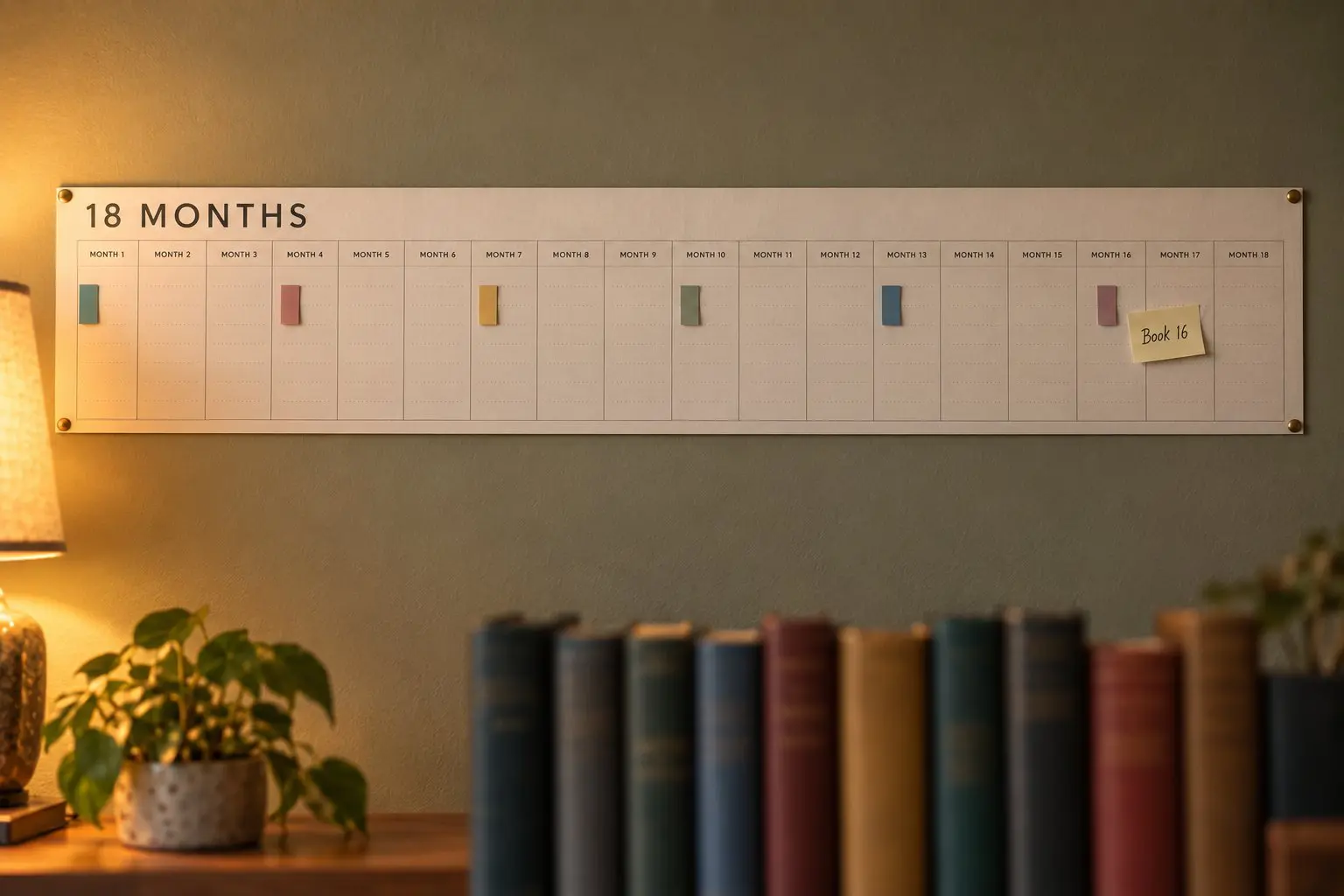
On 2 September Amazon changed the KDP pre-order rules for Kindle eBooks. The announcement came a day later, in a short post that listed the new limits and left out the most interesting part: one of the penalties got considerably lighter.
If you publish a series, this is the most useful thing KDP has done all year. Here is what moved, what stayed put, and one thing to know about the Kindle Unlimited figures that followed a fortnight later.
What changed in the KDP pre-order rules on 2 September
The pre-order window went from twelve months to eighteen. Amazon’s help page puts it plainly:
You can set a release date up to: 18 months in the future (pre-orders created on or after September 2, 2026) 12 months in the future (pre-orders created before September 2, 2026)
You get two postponements instead of one, and far more room to use them. The old rule was a single postponement of up to 30 days. The new one:
Pre-order created on or after September 2, 2026: You can postpone up to 2 times. Your new release date can’t be more than 6 months from your original release date.
And a second strike now costs half what it did. This is the part the announcement skipped. The help page says:
Second cancellation or missed deadline: Your pre-order privileges will be removed for 6 months across your entire catalog.
followed by:
If your pre-order privileges were removed before September 2, 2026, your original penalty period of one year still applies.
That second sentence is the giveaway. The old suspension was a full year. It is now six months.
So this change is not shaped the way it first looks. Amazon lengthened the runway and stretched the slippage allowance from thirty days to six months, then halved the punishment in the same revision. The announcement’s line about a pre-order being “a promise to readers” reads like a warning. The rules underneath it moved in the author’s favour on every count.
What the pre-order rules still say
The 72 hour file deadline. Your final manuscript still has to be uploaded at least three days before release. Miss it and Amazon cancels the pre-order, tells your customers, and counts it as a strike.
The one-time courtesy. A first missed deadline or cancellation still costs nothing:
First missed deadline or cancellation: Your pre-order privileges won’t be removed. This is a one-time account-level courtesy.
Read “account-level” carefully. That is one free pass per account, not one per book, and once it is spent the next slip costs six months across your whole catalogue.
Pre-orders are still eBooks only. KDP has never offered a paperback pre-order. Amazon’s own wording: “For paperbacks, you can’t set up a pre-order, but you can schedule a release date.” Those are different features with different mechanics, and a fair amount of published advice runs them together.
KDP Select is unaffected. You can enrol a pre-order title, and the enrolment term starts on the release date, not the day you set the pre-order up.
Do KDP pre-orders count towards sales rank?
Indie forums will tell you pre-orders are close to useless because the sales “do not count”. Two separate things are being run together there, and they come apart easily enough.
Amazon’s help page states:
Pre-orders contribute toward sales rank and Kindle Store merchandising before your release
That is Amazon’s only published statement on rank mechanics, and it says the opposite of “pre-orders do nothing”.
The belief comes from somewhere else: reporting is deferred. Pre-order sales do not show in your reports until the book is delivered on release day, after which they turn up in Prior Months’ Royalties under a pre-order transaction type.
So rank credit is described as happening during the pre-order window, and royalty reporting happens on release. Those two statements do not conflict. The forum shorthand collapses them into a claim that Amazon’s own documentation contradicts.
What Amazon does not say is whether the rank contribution builds gradually across the window or lands in a lump on release day. That is not published anywhere, and anyone who tells you confidently which way it works is guessing.
What an eighteen-month pre-order window is for
A twelve month ceiling is no constraint at all if you publish a book or two a year. On a series with a fixed cadence it is the binding limit, and it causes one specific, irritating problem.
Back matter. If the last page of Book 9 points a reader at a pre-order for Book 11, that link has to resolve on the day the reader finishes the book, which might be a year after you uploaded the file. Under the old ceiling, a series releasing every other month could keep roughly six future titles on pre-order. Eighteen months covers around nine.
That is the difference between writing back matter around what you are allowed to list and writing it around what you actually intend to publish.
The postponement change matters more than it looks, too. One 30 day slip is thin insurance for a solo publisher on a fixed cadence. Two slips within a six month ceiling is real slack, and it is the difference between quietly moving a date and taking a strike.
The Kindle Unlimited figures, and why the headline is the wrong number
On 15 September Amazon published August’s Kindle Unlimited figures:
For August 2026, KDP authors earned $69.4 million from Kindle Unlimited. The KDP Select Global Fund is $66 million and the All Stars bonus is $3.4 million.
That is down from July’s $71 million, and it would be easy to read a decline into it. Resist that.
Here is the same figure across thirteen months, taken from Amazon’s own monthly announcements rather than from any aggregator:
| Month | Total KU earnings | Global Fund | All Stars |
|---|---|---|---|
| Aug 2025 | $63.5M | $60.1M | $3.4M |
| Sep 2025 | $62.1M | $58.7M | $3.4M |
| Oct 2025 | $64.6M | $61.2M | $3.4M |
| Nov 2025 | $61.6M | $58.2M | $3.4M |
| Dec 2025 | $64.9M | $61.5M | $3.4M |
| Jan 2026 | $65.6M | $62.2M | $3.4M |
| Feb 2026 | $61.7M | $58.3M | $3.4M |
| Mar 2026 | $69.3M | $65.9M | $3.4M |
| Apr 2026 | $67.7M | $64.3M | $3.4M |
| May 2026 | $70.3M | $66.9M | $3.4M |
| Jun 2026 | $67.0M | $63.6M | $3.4M |
| Jul 2026 | $71.0M | $67.6M | $3.4M |
| Aug 2026 | $69.4M | $66.0M | $3.4M |
Three things fall out of that table that a single month cannot tell you.
The August fall is unremarkable. A $1.6 million drop is a small move by this series’ standards. It is exactly the size of the March to April fall, which nobody remarked on, and smaller than eight of the other eleven month-on-month changes in the window. The fund routinely moves by anything from under a million to nearly eight, in either direction.
Over a year, the direction is up. August 2026 is about 9.8% above August 2025 on the fund, and about 9.3% above on total earnings.
The All Stars bonus has not moved at all. $3.4 million every month for thirteen months, so all of the month-to-month movement is in the Global Fund. That is an observation from thirteen data points, not a policy Amazon has stated, but it has held long enough to be worth knowing.
Two things not to do with that number
Do not infer the per-page rate from the fund. The KENP rate is the Global Fund divided by every page read across the whole platform that month, and Amazon publishes the fund but never the pages-read figure. A smaller fund only means a lower rate if pages read held up. It might not have. Every per-page rate you will find published anywhere is somebody’s back-calculation with an unpublished denominator, and none of them can be checked against a primary source, because there is not one.
Say which of the three numbers you mean. Amazon publishes total KU earnings, the Global Fund, and the All Stars bonus, and the first is the sum of the other two. They get conflated constantly. The most-cited aggregator of this data currently lists February 2026’s Global Fund as $61.7 million, which is actually February’s total earnings; the fund was $58.3 million. Its other twelve months are all right, which is exactly what makes the error easy to miss.
The short version
If you run a series, set your pre-orders further out than you used to. The ceiling is eighteen months, you get two slips within six months rather than one of thirty days, and a second strike now costs six months rather than a year. The 72 hour file deadline is unchanged and is still the thing most likely to catch you.
If August’s Kindle Unlimited number worried you, the thirteen month record says it is noise, and the fund is up nearly ten percent on the year.
Sources
- Amazon KDP Help, Kindle eBook Pre-Order: kdp.amazon.com/en_US/help/topic/G201499380
- Amazon KDP Help, Postpone or cancel a pre-order release: kdp.amazon.com/en_US/help/topic/G201499440
- Amazon KDP Help, Setting up pre-orders: kdp.amazon.com/en_US/help/topic/G201575300
- KDP Community announcement, Set up pre-orders up to 18 months in advance, 3 September 2026
- KDP Community, KDP Select Global Fund and All Stars Bonus Update, thirteen monthly announcements from August 2025 to August 2026