Category: Author Life

Notes on writing and independent publishing from Heppe-Smith Publishing: how the books are made, what changes at Amazon KDP, and what it means for authors.

  • The ACX legacy royalty model ends this year: how to decide before the deadline

    The ACX legacy royalty model ends this year: how to decide before the deadline

    In the spring Audible announced that the ACX legacy royalty model would be switched off. The deadline looked comfortably distant then. It is now inside a single quarter, and anyone with an ACX audiobook set up before 26 May has a decision to make before the end of 2026.

    We covered what the new model is and who it favours in June. This piece is about the deadline itself: what ACX has said, what it has not, and how to decide.

    When the ACX legacy royalty model ends

    ACX’s blog post, first published on 28 April and updated on 26 May, reads:

    By end of year, the legacy royalty model will be discontinued. By that time, you must either choose to enroll your titles in the new model or discontinue distribution if you prefer.

    Its help centre says the same, and adds what happens in the meantime:

    If your title is not enrolled in the new royalty model, it will continue to earn a 40% royalty rate for exclusive distribution and a 25% royalty rate for non-exclusive distribution until year-end.

    Two details matter.

    ACX has now named the date: 31 December 2026. Its help page still says only “By end of year”, but ACX’s email to rights holders refers to “the December 31 enrollment deadline”. Enrolment takes effect on the first of the following month, so a title enrolled now moves to the new model in November, and you can see a month of new-model earnings in December, before the deadline.

    Enrolment is not instant. An existing title you enrol moves to the new model on the first of the following month. Enrol on 15 December and the change lands on 1 January.

    Which titles this affects

    Only older ones. Any DIY title claimed after 26 May 2026 is already on the new model, and so is any Marketplace deal (Pay for Production, Royalty Share or Royalty Share Plus) where the offer went to a producer after that date. Anything earlier is not grandfathered.

    Enrolling does not change whether a title is exclusive or non-exclusive. ACX’s FAQ is clear on that:

    No, your title’s distribution status (i.e., exclusive or non-exclusive) will remain unchanged when you enroll in the new royalty model.

    Those are two separate decisions, and switching between exclusive and non-exclusive still runs under ACX’s older rules.

    How to enrol

    From the ACX dashboard:

    1. Open the My Projects tab.
    2. To enrol everything, select Enroll titles on the blue banner at the top of the page.
    3. To enrol some titles only, select Clear selection on the banner, tick the titles you want, then Enroll titles.
    4. Select Confirm.

    A message in your ACX message centre then confirms which titles were enrolled and the date the change takes effect.

    The two questions ACX has not answered

    This is the part that matters most, and the FAQ does not cover it.

    What happens to a title you do nothing about? ACX frames the choice as enrol or discontinue. It does not say what happens to a title that is neither enrolled nor withdrawn when the year ends. Some coverage says such titles will come down. That may well be right, but we could not find ACX saying it.

    Can you undo enrolment? The help centre explains how to enrol and says nothing about reversing it. We found no article on opting back out, and with the legacy model closing anyway, do not assume you can.

    If either answer affects your decision, email ACX support before you act and keep the reply. A written answer from ACX is worth more than any blog post on the subject, this one included.

    How to decide

    The difficulty is that you cannot model it in advance. ACX has no calculator that shows what a title would earn under the new model. The new earnings detail (Member Value by marketplace, Qualified Listens and so on) only appears on your statements after a title is enrolled.

    So the decision rests on what you already know about each title.

    Look at where the title’s income comes from. Your legacy statements show whether a book earns mostly from credit purchases, from à la carte sales, or from very little at all. The new model changes how membership income is shared out, so a title whose money comes mainly from members is the one whose outcome is least predictable.

    Be careful with your best sellers and All You Can Listen. ACX’s own guidance on its All You Can Listen programme is unusually direct:

    We would not recommend titles that are performing well in a credit or monthly unit selection membership model, especially those ranked as bestselling titles on Audible.

    That is Audible telling you not to put a strong-selling credit title into the listen-based pool.

    Treat the headline figures with care. Audible reports that early adopters saw earnings rise by an average of 45 per cent. That comes from a self-selected early group, and Audible has not had it independently checked. It shows the model can work for some catalogues, which is not the same as showing it will work for yours.

    If you have a Royalty Share title, tell your narrator. The rights holder makes the enrolment decision, but the narrator’s income changes too. ACX itself advises narrators to contact rights holders who have not yet enrolled.

    If you decide to leave

    Leaving ACX means finding another route to listeners. The main direct options for authors are Spotify for Authors, Voices by INaudio, Kobo Writing Life and Google Play Books. They pay on different bases from Audible and reach different audiences, so their headline percentages are not directly comparable with ACX’s. Read each one’s terms before you move a title.

    KDP Virtual Voice is not a replacement here. It produces AI-narrated editions of Kindle ebooks for sale within Amazon, and it is not a route for an existing human-narrated ACX audiobook.

    To take a title out of ACX distribution, contact ACX support. We could not find a current help page setting out the removal process, and older instructions circulating online come from ACX’s retired help site.

    The short version

    By the end of 2026 every ACX title from before 26 May has to be enrolled in the new model or taken out of distribution. Enrolment takes effect on the first of the following month, so do it in good time. ACX has not said what happens to titles left alone, or whether enrolment can be reversed, so ask support in writing if either matters to you. And be wary of putting a strong credit seller into All You Can Listen, because Audible itself advises against it.

    Keep reading: Thomson Reuters v. ROSS: what the first appeal ruling on AI training means for authors, Your First 100 Readers: What Actually Works for Indie Authors.


    Sources

  • Thomson Reuters v. ROSS: what the first appeal ruling on AI training means for authors

    Thomson Reuters v. ROSS: what the first appeal ruling on AI training means for authors

    On 29 September a US appeal court ruled for the first time on whether training an AI system on copyrighted material can be fair use. In Thomson Reuters v. ROSS Intelligence, three judges of the Third Circuit said that on the facts in front of them it was not.

    You’ll see it reported as a win for authors. It is a win for a copyright owner, but the case had nothing to do with books and the AI in it couldn’t write a sentence. Even so, one passage does bear on the cases authors are fighting.

    What Thomson Reuters v. ROSS was about

    Thomson Reuters owns Westlaw, the legal research service. Its editors write headnotes, short summaries of the points of law in each court opinion. ROSS, a start-up building a rival legal search tool, hired a contractor to write about 25,000 training memos, each pairing a legal question with passages from court opinions. The contractor’s staff built those questions from Westlaw headnotes.

    The trial judge found that 2,243 headnotes had been copied and that the copying was not fair use. ROSS appealed. It had already closed its platform in 2021, Reuters reports, so the appeal was about liability and the rule itself.

    Why ROSS lost

    American courts weigh four factors to decide fair use. The panel’s summary: “the second factor weighs slightly in favor of fair use, but the first, third, and fourth factors weigh against it.”

    • Purpose. ROSS used the headnotes to build a paid product for the same customers. The court called that “minimally transformative, at best.”
    • Necessity. The court opinions themselves are free for anyone to use. ROSS copied the headnotes because it was quicker. “Unlike necessity, ease is not a justification for copying.”
    • The market. ROSS “copied the headnotes to create a competing legal-research platform in the same market as Westlaw.”

    ROSS also argued that a ruling against it would hold back AI development and touch on national security. It had brought no evidence for either, the court said, and on security it added: “this does not give ROSS carte blanche to violate copyright law merely because it incorporates AI.” This was, in the judges’ words, “no more than an ordinary copyright case.”

    What the ruling does not decide

    The court was careful about the limits of its ruling, and they matter more to authors than the result.

    It is not about generative AI. The opinion says: “ROSS’s AI was not a generative AI, meaning it would not create any new expression; it would only return text passages from preexisting judicial opinions.” The tools in the authors’ cases against OpenAI, Anthropic and Meta do generate new text, and that is the argument those companies rely on to call training transformative.

    The court set the authors’ cases to one side by name. In a footnote it noted the Justice Department’s filing in the OpenAI case, which we covered in our piece on the OpenAI authors case, and said: “The concerns raised in that separate case do not apply here.” It went on: “Unlike the AI models in Bartz and In re: OpenAI, ROSS’s AI platform cannot generate original expression.” The footnote does not say those earlier rulings were right or wrong.

    It says nothing about books, pirated libraries or AI output crowding out human writing. None of those appears in the opinion.

    It binds only part of the country. The Third Circuit covers Delaware, New Jersey, Pennsylvania and the US Virgin Islands. The OpenAI case is in New York and the Anthropic and Meta cases are in California. Judges there can read this ruling and be persuaded by it, but they are not bound to follow it.

    The passage authors should read

    One part of the ruling does travel. Fair use turns partly on harm to the market for the original work, including markets the owner could reasonably license. Thomson Reuters argued that ROSS had damaged its chance to license headnotes as AI training data. The court agreed:

    Here, the evidence shows that the market for licensing headnotes as text to train AI is rapidly developing.

    It also said: “That Thomson Reuters did not license its headnotes to others does not disprove that a market exists to do so.”

    So an appeal court has now treated licensing text for AI training as a real market that copying can harm, which is what authors’ and publishers’ groups have been arguing for. The finding rests on the evidence in this case, though, including the fact that Thomson Reuters trains its own AI search tools on the same headnotes, and the court found harm in the ordinary market as well, because ROSS was building a direct substitute for Westlaw.

    AI companies often cite Authors Guild v. Google, the Google Books case, in which scanning books to make them searchable was held to be fair use. The panel drew the contrast itself. Google’s search “may have driven users toward a book the users would then purchase from the original author.” ROSS’s tool “does not lead a user to Westlaw; instead, as ROSS admits, it aims to replace Westlaw.”

    How it is being read

    The opinion was filed under seal on 29 September and made public the next day, so the first reports were written without the reasoning. Reuters called it “the first copyright dispute over AI training to be heard by a US appeals court,” and noted that the case “does not involve generative AI.”

    Commentators differ on how far it reaches. The legal technology writer Bob Ambrogi put the narrow view before the text was out: “An affirmance that closely follows the facts could be consequential but fairly confined.” Publishers take the wider one. When the Association of American Publishers filed a brief in the case in November 2025, its chief executive Maria Pallante said: “AI is a market to which copyright owners are fundamentally entitled.” That was the publishers’ argument before the ruling. Since it, both the publishers and the Authors Guild have welcomed the decision, Publishers Weekly reported on 2 October. Pallante said the court “correctly noted that the licensing market for AI training not only exists but is ‘rapidly developing.’” Mary Rasenberger, chief executive of the Authors Guild, said the ruling “vindicates copyright law.”

    ROSS does not intend to stop here. On 2 October its lawyer said: “We intend to seek review by the Supreme Court to obtain much-needed clarity on these issues.” That is a statement of intent, not a filing, and the Supreme Court chooses which cases it hears.

    What it means for you

    Nothing changes today. No money flows to authors from this case and no book was involved.

    The arguments have shifted a little your way. Lawyers for authors now have an appeal ruling that rejects “AI is different” as a reason to set copyright aside, and that counts a licensing market for training text as something copying can damage. Lawyers for the AI companies have the court’s own statement that generative AI is another question.

    The ruling to watch is still Judge Stein’s in the OpenAI authors case, where both sides have asked for summary judgment. That one is about books, and about AI that writes.

    In short

    Thomson Reuters v. ROSS is the first appeal ruling on AI training and fair use, and the copyright owner won. It concerned a legal search tool that could not generate text, built to replace the product it copied from, and the court said in terms that the authors’ cases raise different concerns. Read the headlines with that in mind, and keep watching New York.

    Keep reading: Your First 100 Readers: What Actually Works for Indie Authors, Is Kindle Unlimited Worth It for Indie Authors in 2026?.


    Sources

  • The KDP title creation limit is now two per format a week, and the exception route has gone

    The KDP title creation limit is now two per format a week, and the exception route has gone

    On 21 September Amazon cut the KDP title creation limit from ten new titles per format a week to two. The announcement was short, and it left out the part that matters most to anyone who publishes at volume: the sentence telling you how to ask for more has been taken off the help page.

    For most authors this changes nothing. For series authors, small presses, and anyone relaunching a back catalogue, it is worth ten minutes with a calendar.

    On 5 October Amazon added a second cap, this time on how many new titles you can submit for publication each week. It is covered below, and it changes the planning advice.

    What the new KDP title creation limit says

    KDP’s announcement, dated 22 September, reads:

    Starting Monday, September 21, 2026, you can create up to 2 titles per format per week.
    Your weekly limit resets every Sunday at 12:00 AM UTC.

    The FAQ underneath adds three answers. Existing and already published titles are not affected. The limit applies to eBook, paperback and hardcover separately (“You can create 2 titles per format per week”). And if you hit it, you wait for the Sunday reset.

    That was the whole of Amazon’s published guidance when the change was announced. It was three questions long.

    The sentence that disappeared

    KDP’s Create a Book help page has carried a title creation limit for some time. An archived copy from 25 August 2026 reads:

    To ensure a positive experience for all authors, we limit the number of titles you can create at the same time to 10 per book format each week. If you expect to regularly create a large number of titles, please contact us to inquire about an exception.

    The same page on 23 September:

    To ensure a positive experience for all authors, we limit the number of titles you can create at the same time to 2 per book format each week.

    Two things changed. The number fell by four fifths, and the second sentence went. Before, a publisher who needed more capacity had a documented route to ask for it. Now there is no route on the page at all. That does not prove Amazon will refuse every request, but it does mean you should plan as if the limit is fixed.

    A second limit, added on 5 October

    Added 7 October 2026. Two weeks after the first change, KDP put a new line at the top of the same announcement:

    [Update as of October 5, 2026] In addition to the title creation limits, you can now submit up to 2 new titles per book format each week for publication. This limit counts the first time you submit a title for publication, including titles saved as drafts. Updates to titles you previously submitted do not count toward the weekly submission limit.

    The Create a Book help page now lists the two limits side by side and adds:

    These limits are separate from each other, apply separately to each book format (eBook, paperback, and hardcover), and reset every Sunday at 12:00 AM Coordinated Universal Time (UTC).

    So each format now has two counters, both set at two a week. One counts the titles you create. The other counts the titles you send for publication for the first time. Fixing a typo or changing the price on a book you have already submitted uses neither.

    What counts as a title

    Amazon does not say what act “creates” a title, and it does not address the cases people are asking about. What KDP’s own workflow shows is that each format, whether ebook, paperback or hardcover, is set up as a separate entry on your Bookshelf and then linked to the others. So each format is its own title in KDP’s system, and the limit is counted per format.

    Read that way (and this is our reading, not a statement Amazon has made), the cases look like this:

    • A paperback of an ebook you published last year is a new paperback title and uses one of that week’s paperback slots.
    • A box set is a new title with its own detail page, so it uses a slot in each format you create it in.
    • A translation or a new edition is also a new title.
    • Pen names do not get their own allowance. The limit belongs to the account, and every pen name publishing from one Bookshelf draws on the same six weekly slots. Amazon has not said this in so many words, but nothing in how the Bookshelf works suggests otherwise.
    • A draft you started before 21 September already exists, so on the FAQ’s own logic it should not count again as a creation when you return to it. Amazon has not confirmed this either. It will count towards the submission limit in the week you first submit it, because the help page says that limit “includes titles previously saved as drafts”.

    If any of those matters to a launch you have planned, ask KDP support before you rely on it.

    What it means for a release plan

    The limit is per format, so one book released as an ebook, a paperback and a hardcover uses one slot in each. You can still put out two complete books in every format in the same week.

    Where it bites is anything that stacks titles:

    • Back catalogue relaunches. Eight books going up in ebook and paperback together now take four weeks, not one.
    • Box sets alongside new releases. Two ebook box sets created in the same week use both ebook slots, so nothing else in ebook goes up that week.
    • Small presses and multi-author accounts. Every author and every pen name on the account shares the six weekly slots.

    At Heppe-Smith we release a new book every other month, so a normal week never comes close. The weeks to watch are the unusual ones, such as a week with a box set or two going up, and the answer then is simply to plan what else goes up in that format that week.

    Creating is not publishing, and both are now limited

    The first limit counts titles you create. The second counts titles you submit for publication for the first time. Neither sets the date a book goes on sale. A title you submit this week can go up on pre-order and be released weeks later. Since 2 September KDP has let you set an ebook pre-order up to eighteen months ahead.

    Setting up a pre-order means submitting the title, so on our reading it uses a submission slot in the week you set it up, not in release week. Amazon has not said so in terms.

    So if a launch needs more than two titles in one format, spread both steps over the weeks before it. Create the titles early and submit them early. For ebooks a pre-order lets you do that without moving the release date. Where you cannot use a pre-order, the titles will have to go live across more than one week. What no longer works is preparing everything as drafts and submitting the lot in launch week, because a draft counts when it is first submitted.

    Why Amazon did it

    Amazon’s only stated reason is the one in the announcement: “to help maintain a positive publishing experience for all authors.”

    The history points the same way as most of the reporting. When KDP first capped title creation in September 2023, at three a day, it said the cap was there “to help protect against abuse”, at a time when AI-generated submissions were the obvious concern. The Alliance of Independent Authors reads the 2026 cut as part of the same effort. Amazon has published no figures on submission volumes, and nobody outside Amazon has them, so treat any number you see attached to this change with suspicion.

    The short version

    From 21 September you can create two titles per format per week on KDP: two ebooks, two paperbacks and two hardcovers, resetting at midnight UTC on Sunday. Existing titles are untouched. The old limit was ten, and the help page no longer offers an exception. From 5 October you can also submit no more than two new titles per format a week for publication, and a draft counts when it is first submitted. If a launch needs more than that, create and submit the titles across the weeks beforehand.

    If you are publishing your first book, none of this will get in your way. Our KDP setup guide walks through the whole process.

    Keep reading: The ACX legacy royalty model ends this year, Thomson Reuters v. ROSS: what the first appeal ruling on AI training means for authors.


    Sources

  • OpenAI authors case: the US government says AI training is fair use. What it means for you

    OpenAI authors case: the US government says AI training is fair use. What it means for you

    On 1 September the US Department of Justice stepped into the OpenAI authors case, the biggest copyright fight authors have with an AI company, and it didn’t take the authors’ side. In a filing in the consolidated case in New York, the government argued that training AI models on books is fair use, calling it “extraordinarily transformative.”

    That sounds like a turning point. It isn’t, or not yet. Here is what the filing is and isn’t, where the OpenAI authors case stands, and what it means for you, whether you publish in the US, the UK or both.

    What the government filed

    The document is a Statement of Interest. A federal law lets the Justice Department tell a court what the United States thinks about a case it isn’t a party to, and that is what this is. It went in under In re OpenAI, Inc. Copyright Infringement Litigation, the case before Judge Sidney Stein in the Southern District of New York that bundles the news publishers’ claims with the Authors Guild’s class action for book authors.

    Reports of the 20-page filing put the government’s argument in three parts:

    • Training is transformative. Copying books to build a model serves a different purpose from the books themselves, so it should count as fair use.
    • Training doesn’t replace the books. The government’s view is that training on a work, taken on its own, doesn’t generally produce a substitute for it.
    • Licensing would help only the biggest firms. IPWatchdog reports the filing’s warning that requiring licences “could create entry barriers that only the largest technology companies could absorb,” and that it frames the question partly as one of American competitiveness against China.

    One limit matters. The argument covers training, and only training. As dig.watch summarises it, the government leaves open that some uses may not be transformative where a model reproduces and spreads an original copyrighted work. A model that spits out chunks of your book is a separate question.

    Why it isn’t a ruling

    A Statement of Interest is advocacy. It isn’t evidence, it isn’t law and it doesn’t bind the judge. Judge Stein can adopt its reasoning, ignore it or take the parts he finds useful. What it does tell us is where the current administration stands on AI and copyright, in this case and probably in others to come.

    Where the OpenAI authors case stands

    The case has reached summary judgment, the stage where each side asks the judge to settle the main questions without a trial. OpenAI filed its motion on 4 September, and the Authors Guild says it and its co-plaintiffs filed theirs the same day. On 24 September the judge moved the remaining deadlines back by two weeks for every party: opposition briefs are now due on 23 October, friend-of-the-court briefs on 30 October and replies on 20 November. No hearing date has been reported.

    On 21 September the Authors Guild also released newly unsealed briefs from the case. The Guild says they show OpenAI and Microsoft executives knew about the use of pirated book libraries and went ahead anyway. That is the Guild’s reading of discovery documents, an allegation rather than a finding by the court. It matters because it goes to how the books were obtained, and that is where authors have done best so far.

    What the courts have said so far

    Two rulings from June 2025 set the scene. Both left a door open.

    • Bartz v. Anthropic. Judge William Alsup found training on lawfully bought books to be fair use, and building a library of millions of pirated books not to be. The piracy finding is what led to Anthropic’s $1.5 billion settlement with authors.
    • Kadrey v. Meta. Judge Vince Chhabria ruled for Meta on training, then said the authors might well have won on an argument they never made: that AI output floods the market and dilutes demand for human-written books.

    Added 1 October 2026. An appeal court has since ruled on a narrower question. On 29 September the Third Circuit held in Thomson Reuters v. ROSS Intelligence that copying Westlaw’s headnotes to train a legal search tool was not fair use. The court stressed that ROSS’s tool was not generative AI, and in a footnote it said of the Justice Department’s OpenAI filing that the concerns raised there “do not apply here.” So a copyright owner has won on appeal, and the question in the OpenAI authors case is where it was.

    That second door is the one to watch. The government’s claim that training doesn’t produce substitutes reads like an attempt to shut it before Judge Stein gets there. Whether he agrees is the open question.

    What it means for you

    Nothing changes today. Your copyright is as strong as it was in August. The filing is an opinion offered to a judge who hasn’t decided anything yet.

    If you claimed in the Anthropic settlement, that is the one pot of money heading to authors right now. The first distribution is expected in November. The claims deadline passed on 30 March 2026, so there is no joining it now. The Authors Guild’s settlement guide has the detail.

    If you publish in the US, registration matters. In American copyright cases, whether you registered a work with the US Copyright Office affects what you can claim if it is infringed. Plenty of indie authors never do. The Copyright Office’s registration pages explain how.

    If you’re in the UK, no new law is coming soon. In March 2026 the UK government published its report on copyright and AI and dropped its earlier plan for an exception that would have let AI firms train on works unless creators opted out. It hasn’t legislated and says it will gather more evidence. So the existing law stands, and the US cases matter more to UK authors than they might appear to, because that is where the big AI companies are being tested.

    In short

    The US government has told the judge in the OpenAI authors case that it thinks AI training on books is fair use. That is a strong signal, not a decision. The case is mid-briefing, the question of AI output crowding out books is still open, and the courts have already drawn a hard line on piracy. Keep your rights paperwork in order and watch for Judge Stein’s ruling. That is the one that counts.

    For more on protecting your author business, see our pieces on the scam emails that quote your own book and this year’s KDP and ACX changes.


    Sources

  • The new KDP pre-order rules: eighteen months, two postponements and a shorter penalty box

    The new KDP pre-order rules: eighteen months, two postponements and a shorter penalty box

    On 2 September Amazon changed the KDP pre-order rules for Kindle eBooks. The announcement came a day later, in a short post that listed the new limits and left out the most interesting part: one of the penalties got considerably lighter.

    If you publish a series, this is the most useful thing KDP has done all year. Here is what moved, what stayed put, and one thing to know about the Kindle Unlimited figures that followed a fortnight later.

    What changed in the KDP pre-order rules on 2 September

    The pre-order window went from twelve months to eighteen. Amazon’s help page puts it plainly:

    You can set a release date up to: 18 months in the future (pre-orders created on or after September 2, 2026) 12 months in the future (pre-orders created before September 2, 2026)

    You get two postponements instead of one, and far more room to use them. The old rule was a single postponement of up to 30 days. The new one:

    Pre-order created on or after September 2, 2026: You can postpone up to 2 times. Your new release date can’t be more than 6 months from your original release date.

    And a second strike now costs half what it did. This is the part the announcement skipped. The help page says:

    Second cancellation or missed deadline: Your pre-order privileges will be removed for 6 months across your entire catalog.

    followed by:

    If your pre-order privileges were removed before September 2, 2026, your original penalty period of one year still applies.

    That second sentence is the giveaway. The old suspension was a full year. It is now six months.

    So this change is not shaped the way it first looks. Amazon lengthened the runway and stretched the slippage allowance from thirty days to six months, then halved the punishment in the same revision. The announcement’s line about a pre-order being “a promise to readers” reads like a warning. The rules underneath it moved in the author’s favour on every count.

    What the pre-order rules still say

    The 72 hour file deadline. Your final manuscript still has to be uploaded at least three days before release. Miss it and Amazon cancels the pre-order, tells your customers, and counts it as a strike.

    The one-time courtesy. A first missed deadline or cancellation still costs nothing:

    First missed deadline or cancellation: Your pre-order privileges won’t be removed. This is a one-time account-level courtesy.

    Read “account-level” carefully. That is one free pass per account, not one per book, and once it is spent the next slip costs six months across your whole catalogue.

    Pre-orders are still eBooks only. KDP has never offered a paperback pre-order. Amazon’s own wording: “For paperbacks, you can’t set up a pre-order, but you can schedule a release date.” Those are different features with different mechanics, and a fair amount of published advice runs them together.

    KDP Select is unaffected. You can enrol a pre-order title, and the enrolment term starts on the release date, not the day you set the pre-order up.

    Do KDP pre-orders count towards sales rank?

    Indie forums will tell you pre-orders are close to useless because the sales “do not count”. Two separate things are being run together there, and they come apart easily enough.

    Amazon’s help page states:

    Pre-orders contribute toward sales rank and Kindle Store merchandising before your release

    That is Amazon’s only published statement on rank mechanics, and it says the opposite of “pre-orders do nothing”.

    The belief comes from somewhere else: reporting is deferred. Pre-order sales do not show in your reports until the book is delivered on release day, after which they turn up in Prior Months’ Royalties under a pre-order transaction type.

    So rank credit is described as happening during the pre-order window, and royalty reporting happens on release. Those two statements do not conflict. The forum shorthand collapses them into a claim that Amazon’s own documentation contradicts.

    What Amazon does not say is whether the rank contribution builds gradually across the window or lands in a lump on release day. That is not published anywhere, and anyone who tells you confidently which way it works is guessing.

    What an eighteen-month pre-order window is for

    A twelve month ceiling is no constraint at all if you publish a book or two a year. On a series with a fixed cadence it is the binding limit, and it causes one specific, irritating problem.

    Back matter. If the last page of Book 9 points a reader at a pre-order for Book 11, that link has to resolve on the day the reader finishes the book, which might be a year after you uploaded the file. Under the old ceiling, a series releasing every other month could keep roughly six future titles on pre-order. Eighteen months covers around nine.

    That is the difference between writing back matter around what you are allowed to list and writing it around what you actually intend to publish.

    The postponement change matters more than it looks, too. One 30 day slip is thin insurance for a solo publisher on a fixed cadence. Two slips within a six month ceiling is real slack, and it is the difference between quietly moving a date and taking a strike.

    The Kindle Unlimited figures, and why the headline is the wrong number

    On 15 September Amazon published August’s Kindle Unlimited figures:

    For August 2026, KDP authors earned $69.4 million from Kindle Unlimited. The KDP Select Global Fund is $66 million and the All Stars bonus is $3.4 million.

    That is down from July’s $71 million, and it would be easy to read a decline into it. Resist that.

    Here is the same figure across thirteen months, taken from Amazon’s own monthly announcements rather than from any aggregator:

    MonthTotal KU earningsGlobal FundAll Stars
    Aug 2025$63.5M$60.1M$3.4M
    Sep 2025$62.1M$58.7M$3.4M
    Oct 2025$64.6M$61.2M$3.4M
    Nov 2025$61.6M$58.2M$3.4M
    Dec 2025$64.9M$61.5M$3.4M
    Jan 2026$65.6M$62.2M$3.4M
    Feb 2026$61.7M$58.3M$3.4M
    Mar 2026$69.3M$65.9M$3.4M
    Apr 2026$67.7M$64.3M$3.4M
    May 2026$70.3M$66.9M$3.4M
    Jun 2026$67.0M$63.6M$3.4M
    Jul 2026$71.0M$67.6M$3.4M
    Aug 2026$69.4M$66.0M$3.4M

    Three things fall out of that table that a single month cannot tell you.

    The August fall is unremarkable. A $1.6 million drop is a small move by this series’ standards. It is exactly the size of the March to April fall, which nobody remarked on, and smaller than eight of the other eleven month-on-month changes in the window. The fund routinely moves by anything from under a million to nearly eight, in either direction.

    Over a year, the direction is up. August 2026 is about 9.8% above August 2025 on the fund, and about 9.3% above on total earnings.

    The All Stars bonus has not moved at all. $3.4 million every month for thirteen months, so all of the month-to-month movement is in the Global Fund. That is an observation from thirteen data points, not a policy Amazon has stated, but it has held long enough to be worth knowing.

    Two things not to do with that number

    Do not infer the per-page rate from the fund. The KENP rate is the Global Fund divided by every page read across the whole platform that month, and Amazon publishes the fund but never the pages-read figure. A smaller fund only means a lower rate if pages read held up. It might not have. Every per-page rate you will find published anywhere is somebody’s back-calculation with an unpublished denominator, and none of them can be checked against a primary source, because there is not one.

    Say which of the three numbers you mean. Amazon publishes total KU earnings, the Global Fund, and the All Stars bonus, and the first is the sum of the other two. They get conflated constantly. The most-cited aggregator of this data currently lists February 2026’s Global Fund as $61.7 million, which is actually February’s total earnings; the fund was $58.3 million. Its other twelve months are all right, which is exactly what makes the error easy to miss.

    The short version

    If you run a series, set your pre-orders further out than you used to. The ceiling is eighteen months, you get two slips within six months rather than one of thirty days, and a second strike now costs six months rather than a year. The 72 hour file deadline is unchanged and is still the thing most likely to catch you.

    If August’s Kindle Unlimited number worried you, the thirteen month record says it is noise, and the fund is up nearly ten percent on the year.


    Sources

    • Amazon KDP Help, Kindle eBook Pre-Order: kdp.amazon.com/en_US/help/topic/G201499380
    • Amazon KDP Help, Postpone or cancel a pre-order release: kdp.amazon.com/en_US/help/topic/G201499440
    • Amazon KDP Help, Setting up pre-orders: kdp.amazon.com/en_US/help/topic/G201575300
    • KDP Community announcement, Set up pre-orders up to 18 months in advance, 3 September 2026
    • KDP Community, KDP Select Global Fund and All Stars Bonus Update, thirteen monthly announcements from August 2025 to August 2026
  • The Scam Email That Has Read Your Book

    The Scam Email That Has Read Your Book

    By James Heppe-Smith · 9 min read

    The email arrives on a Tuesday. Someone has read your book. Not skimmed the blurb, read it: they mention the sister, the bit in the third act you were never sure worked, the line you nearly cut. They loved it. They represent a literary agency you can look up, and the agency is real, and so is the person whose name is at the bottom. They would like to know whether you are currently represented.

    You know how this ends, because you are reading an article about scams. On a Tuesday, with a book you have been quietly worried about, you might not.

    I get several of these a week. Most authors I know get more. Author scam emails are not new. What has changed over the last year is that they have stopped announcing themselves, and the old habit of spotting one by its bad English no longer works.

    What changed: the writing, not the fraud

    The shape of the fraud is old. Unsolicited flattery, then a referral, then a fee for a service you did not ask for. Vanity presses were doing it before the internet. Fake agents were doing it in the 1990s. Writer Beware has been chronicling the pattern for two decades.

    What generative AI added is specificity, at no cost, at volume. The Authors Guild put it plainly in its scam alert of 20 August 2026: “The scammers can now use AI to write their approaches and can sound like they’ve actually read your work. We are far from the days when poor use of English and improper capitalization were easy indications of a scam.”

    That is the whole change. Every author I know ran the same internal filter: wrong grammar, random capitals, bin it. It did a lot of work for a lot of years, and it has quietly stopped functioning. The emails are now well written, correctly punctuated, and appear to know your plot.

    Victoria Strauss, who runs Writer Beware and has been tracking this wave since the summer of 2025, calls it “the most prolific and aggressive I’ve ever chronicled”. She updates her list of impersonated names “daily, sometimes multiple times a day”.

    The three shapes doing the rounds in 2026

    Strauss published an update on 28 August 2026 covering what has appeared in the last few weeks. Three variants are worth knowing by sight.

    1. The literary agent who is real, and the email that is not

    This is the one that worries me most, because the first check most authors run is the one it defeats. A literary agent emails you out of the blue. You google them. They exist, at a real agency, with a real client list. Everything checks out.

    Strauss describes the mechanics: the impersonator asks whether you are represented, asks you to send your query letter and manuscript, and then “after an improbably short period of just a few days, refers you to an ‘editor’ who can fix whatever is wrong with your query letter or manuscript, for, of course, a sizeable fee.” Her line on who you are dealing with is the one to remember: “The scammer inhabits both personas.”

    The agency did nothing wrong. The agent is a victim too, and several named agents have had their identities used this way. The tell is not the person, it is the address: a Gmail account with the agent’s name mashed together with their agency, rather than the agency’s own domain.

    2. The production company that found you

    New in the last few weeks. Someone claiming to be a founder or producer at a film or television production company writes to say they have read the book and can see it on screen.

    Strauss’s two-part test for this one is the most quotable thing in her post, and I would pin it above the desk: “a) a production company reaching out to you directly is one of the least likely things ever to happen to you as a writer, and b) in the incredibly rare event that it does, the email will come from a company domain, not a Gmail or other non-professional address.”

    The Authors Guild is seeing the same thing from the celebrity end. One writer, it reports, “received emails from someone pretending to be Reese Witherspoon.”

    3. The same pitch, now in German

    Until recently this wave was English only. Strauss has now had several reports of the identical marketing solicitation arriving in German: the same offer of Amazon visibility and Goodreads presence, the same Gmail address, the same praise, the same marketers who cannot be found online anywhere.

    If you write in more than one language, or your books are translated, the assumption that you are safe outside English does not hold any more.

    One detail from the German examples explains the whole business model. Both emails end by inviting a reply. One asks a friendly open question about how you find your readers. The other makes it even easier: reply with the single word “Interested”. That is the point of the exercise, as Strauss says: the reply “is intended to incentivize response, so that the scammer can draw the writer in over an often-lengthy series of email exchanges designed to make it harder to say ‘no’ when the money ask finally arrives.”

    Spotting author scam emails: the tells that still work

    Since the writing quality no longer tells you anything, here is what does. Most of these take a few seconds.

    • The address, before anything else. A Gmail address from someone whose organisation would obviously have its own domain is the single most reliable signal in the whole set.
    • A salutation nobody uses. “Dear Jane Smith” rather than “Dear Jane” or “Dear Ms Smith”. Or “Dear Author”. Or none at all.
    • Accurate plot detail plus heavy praise, together. Either alone is fine. Both at once, from a stranger, is the signature of this wave.
    • A name that does not match itself. The signature says one spelling, the email address says another. Strauss flags this as a common marker, and it is the sort of thing you only catch if you look.
    • Nudging. “Just following up on my last email”, sometimes within hours of the first one.
    • A fee where a fee does not belong. Real book clubs, radio shows and conferences do not charge invited guests. Optioning film rights should never involve you paying anyone.
    • Payment methods you cannot reverse. Wire transfer, PayPal Friends and Family, Zelle, CashApp, or an invoice through Upwork or Fiverr.
    • An invoice missing the boring details. No company address, no phone number, no registered name. Scammers avoid anything that creates accountability.
    • A team with no online footprint. A marketing agency whose staff cannot be found anywhere is not a marketing agency.

    One more, and it applies to the phone as well as the inbox. The Authors Guild has had reports of these approaches coming by telephone, and its advice there is specific: do not agree to anything on the call, because “even using the word ‘Yes’ can be recorded and used later.”

    Two minutes on the email address

    Strauss wrote a companion piece on 30 June 2026 devoted entirely to sender addresses, and it is the most practical thing I have read on this. Three patterns beyond the plain Gmail account:

    • Lookalike domains. A domain that is almost right. She gives real examples: an address at “thepenguinrandomhouse.com” when the real domain has no “the”, or a “hachettebookgroup.ink” when the real one ends differently.
    • Single-character switches. A number standing in for a letter, two letters transposed, one letter added or dropped. “Pengu1n”. “HarpreCollins”. “Hachett”. Strauss notes this technique was used by the manuscript thief Filippo Bernardini, and it is hard to spot at a glance.
    • A domain with nothing behind it. Paste the bit after the @ into a browser. Often there is no website at all, or a placeholder.

    That last check takes about ten seconds and it is the one I would build the habit around. A real publisher has a website at the address its staff email from.

    The rule that covers everything above

    As a general rule of thumb, if they contact you (rather than the other way around), the odds are very high that it’s a scam. Reputable publishers, agents, etc. don’t acquire authors by cold-calling them. You’re safest if you assume that ANY out of the blue publishing- or movie rights-related phone call or email is a scam, unless you can directly tie it to a query or contact that you yourself made.

    Victoria Strauss, Writer Beware

    It is a blunt rule and it will occasionally be wrong. It is still the right default, because the cost of being wrong in that direction is a slightly delayed reply to a genuine approach, and the cost of being wrong in the other direction is several hundred pounds and a bad month.

    If you have already paid

    Two things, in order.

    First, and this one is genuinely nasty: expect a second approach. The Alliance of Independent Authors flags what its Watchdog Desk calls victim retargeting. A scammer takes money from an author until the author works it out and cuts contact. Then the same operation comes back “under a different name, posing as a law firm or law enforcement, claiming they can recover the stolen money, for a fee.” An offer to get your money back is the second half of the same scam.

    Second, report it. It feels pointless and it is not: these lists are how the warnings get written.

    The Society of Authors and the Writers’ Guild of Great Britain published joint anti-scammer guidance in August 2026, and if you are a member, the SoA will look at a suspicious approach for you. One member quoted in that coverage had believed she was dealing with the publishing arm of a well-known bookshop chain, and said afterwards: “I got wary before any commitments were made and had the sense to ask SoA’s opinion. They saved me from making an expensive mistake.”

    On the numbers, honestly

    You will see figures attached to this. Be careful with them. There is no reliable count of how many authors are targeted or how much money is lost, and I would rather say so than repeat something confident and unsourced.

    What can be said: every organisation tracking this describes it as widespread and rising. Authors commenting under Strauss’s post report anything from four to over a hundred solicitations a day. That is self-reported, not surveyed, and it plainly depends on how public your author profile is. The one hard figure I found is ALLi’s, which says its Watchdog Desk handles between 2,000 and 3,000 messages a year from authors wanting help or a second opinion. That measures people asking questions rather than people defrauded, which is a different and more hopeful thing.

    What we do at Heppe-Smith Publishing

    We treat every unsolicited approach as fake until something independent says otherwise, and we check the domain before we read the message. That sounds cynical for a small press. It is not, really: it just moves the burden of proof to where it belongs. If an offer is real, it survives a ten-second check comfortably.

    The habit worth building is not suspicion, it is a pause. The whole business model depends on an author reading a flattering email at the end of a long day and replying before thinking. ALLi’s John Doppler puts it best: “They know the pain points that authors face. They know what authors want to hear, what reassures them, what lowers their defenses.”

    Nothing you actually want will disappear because you slept on it.

    Not sure about one you have received?

    Forward it to someone before you reply. Writer Beware, ALLi’s Watchdog Desk and the Society of Authors all do this for free, and would rather see one more email than one more author out of pocket. If you would like a second pair of eyes from us instead, our services page has the contact details, and telling you an email is a scam does not cost anything.

  • Time Management for Writers With Day Jobs

    Time Management for Writers With Day Jobs

    By William Smith · 9 min read

    Most people who want to write a book believe they are short of time. They are not, or at least not in the way they think. They are short of a system that fits the life they already have. You will almost never find a clear weekend or a free fortnight; you have to make writing time out of the ordinary, cluttered day you already own. I wrote a whole book about this idea, Unleashing the 25th Hour, but the core of it for writers fits in one article. Here it is.

    Disclosure: Heppe-Smith Publishing is a participant in the Amazon Associates programme. This post contains affiliate links, and if you buy a book through one of them we may earn a small commission at no extra cost to you. As an Amazon Associate, we earn from qualifying purchases. We only recommend books we genuinely rate.

    Stop waiting for the big block of time

    The single most expensive belief a working writer holds is that real writing needs a long, uninterrupted stretch. It almost never arrives, and when it does, you are usually too tired to use it. The writers who actually finish books around a job are not the ones who found a spare day. They are the ones who stopped waiting for it and started using the small pockets they already had.

    The good news is that small pockets are enough, because of the maths.

    The small-and-steady maths

    A novel is long, but the daily number you need is not. Look at what consistency actually produces:

    Words per dayIn a year (writing most days)
    250 words (about 15 minutes)roughly 80,000 to 90,000 words, a full novel
    500 words (about half an hour)roughly 160,000 words, two novels or a big one with room to cut
    1,000 words (a focused hour)a novel in a few months

    Two hundred and fifty words is a paragraph or two. It is the time you spend scrolling while the kettle boils. Written most days, it is a book a year, every year, around a full-time job. The lesson is not to aim higher. It is to aim small enough that you actually do it, because a number you hit every day beats a number you hit once a fortnight and then abandon.

    Find your slot and defend it

    Decide when you write, attach it to something that already happens every day, and then guard it like a meeting you cannot move. Before the house wakes. The first fifteen minutes of your lunch break. The train. The half hour after the children are down. The exact slot matters less than its consistency. A fixed, repeated time becomes a habit, and a habit removes the daily negotiation with yourself about whether you feel like writing. You will not always feel like it. The slot is what carries you on the days you do not.

    Tell the people you live with that this slot is real work, because it is. Protecting it is not selfish; it is the only way the book gets written.

    Lower the friction to almost nothing

    Every second of setup is a chance to give up. Make starting effortless. Leave the document open on the screen, scrolled to where you stopped. Keep a one-line note at the end of yesterday’s work telling you what happens next, so you never open to a blank page cold. Write on whatever is to hand; a notes app on your phone counts. The goal is that when your slot arrives, there is nothing between you and the next sentence.

    Spend your best energy on the page, not the easiest hour

    Time and energy are not the same currency. Ten o’clock at night might be free, but if you are running on empty, the words will be poor and slow. Many working writers do better with fifteen sharp minutes in the morning than an exhausted hour at the end of the day. Notice when your mind is at its best and give that window to the writing, even if it is small. Hand the dull, low-energy time to the admin instead.

    Give yourself permission to write badly

    Perfectionism is procrastination wearing a respectable coat. When you only have fifteen minutes, you cannot afford to spend ten of them judging the sentence you just wrote. A first draft exists to be finished, not to be good. You can fix a clumsy paragraph in the edit; you cannot fix a blank page. Let the draft be rough, keep moving forward, and trust your later self to tidy it up.

    Track the streak, not the word count

    What you measure is what you protect. Counting words can discourage you on a slow day. Counting days you showed up rewards the behaviour that actually finishes books. Mark every day you wrote, even fifty words, on a calendar or an app, and try not to break the chain. After a couple of weeks the unbroken run becomes its own motivation; you will write a token amount on a bad day purely to keep it alive, and a token amount on a bad day is exactly the win you want.

    Keep the admin out of the writing slot

    If you self-publish, the business will try to eat the writing. Formatting, covers, ads, email, metadata: all of it feels productive, and none of it is the book. Batch that work into its own separate time, ideally your low-energy time, and keep it out of your protected writing slot entirely. The writing is the asset. Everything else is in service of it, and it can wait until the words are done.

    Play the long game

    A sustainable pace you can hold for years will always beat a heroic sprint that burns out in a month. The writers who build real catalogues are rarely the fastest; they are the most consistent. Pick a daily number small enough to survive a bad week, protect your slot, and let the pages compound. That is the whole system, and it works precisely because it does not depend on a perfect day that never comes.

    Frequently asked questions

    How long does it take to write a book at 250 words a day?

    Writing most days, a typical novel of 80,000 to 90,000 words takes roughly a year of first-draft work, plus editing time. Increase the daily number and the timeline shortens; the key is choosing a number you will actually hit.

    Should I write every day or take days off?

    A near-daily habit is easier to sustain than a few intense sessions a week, because it removes the restart cost. If you need rest days, schedule them deliberately rather than letting them happen by default, and protect the streak the rest of the time.

    What if I miss a day?

    Miss one, never two. A single missed day is life. Two in a row is how a habit quietly dies. The rule that protects working writers is simple: get back in the slot the very next day, even for fifty words.

    Go deeper

    This is the writer’s version of a system I set out in full in Unleashing the 25th Hour, my book on making usable time out of an ordinary day. If you want the complete approach, beyond writing, it goes into the habits, the energy management, and the small structural changes that give most people the equivalent of an extra hour a day.


    William Smith writes practical books on productivity, business, and getting more from your time, including Unleashing the 25th Hour. He publishes with Heppe-Smith Publishing.

  • What Writing a 20-Book Series Has Taught Me About Series Strategy

    What Writing a 20-Book Series Has Taught Me About Series Strategy

    By James Heppe-Smith · 11 min read

    When I started The Last Route, I committed to something a little mad: a planned twenty-book cozy fantasy series, released on a steady schedule, all the way through. As I write this I am nine books in, with the tenth already finished and on pre-order. That is far enough to have learned what the how-to articles get right, what they gloss over, and what only shows up once you are actually living inside a long series. Here is the honest version.

    Why series win in indie publishing

    The whole economics of indie fiction tilts toward series, and once you see why, you cannot unsee it. A standalone has to win a reader from scratch every single time. A series wins a reader once, with Book 1, and then every later book sells to a warm audience that already trusts you. One happy reader of Book 1 can become eight or twelve or twenty sales, not one.

    That read-through is also what makes Kindle Unlimited pay. Subscribers who fall for the first book binge the rest, and you are paid for every page. A series with strong read-through is the single best fit for KU there is, which is exactly why The Last Route lives in KDP Select. Series turn a marketing problem (finding new readers) into a far easier retention problem (keeping the ones you have).

    Decide the shape before you write Book 1

    The biggest planning lesson: know what kind of series you are writing before you commit. Broadly there are two shapes. An arc series tells one big story across the books, with cliffhangers pulling readers forward. An episodic series gives each book a satisfying, self-contained story while a gentle through-line and a cast of beloved characters carry across the whole run.

    The Last Route is mostly episodic, which suits cozy fantasy: each book is a complete journey for Wren, my postal courier, while the slow-burn romance and the growing found family build across the series. Episodic is more forgiving over twenty books, because no single instalment carries the weight of resolving everything. If you are planning something long, episodic with a through-line is the more sustainable structure. Arc series are gripping but unforgiving; one weak middle book can sink the whole thing.

    Whichever you choose, build a series bible early. I keep a canon document for Aeldra, the world of The Last Route: geography, characters, what happened when, small details readers will catch if I contradict them. By Book 8 you cannot hold it all in your head, and readers absolutely will notice when the inn changes name.

    Cadence beats speed

    The advice you hear is “rapid release”, publish fast to ride the algorithm. The version that has actually worked for me is gentler: a predictable cadence rather than a punishing one. The Last Route comes out every couple of months, on the same kind of schedule each time, so readers know roughly when the next book lands. Predictability does two things. It trains readers to expect you, which builds anticipation and pre-orders. And it sets a pace you can hold for years, which matters far more over twenty books than a fast start you cannot sustain.

    Pick a rhythm you can keep through a bad month, not just a good one. A series that arrives reliably beats a series that sprints and then stalls, because nothing kills a series’s momentum like a long, unexplained silence.

    Book 1 carries the entire series

    Every reader you will ever have meets the series through Book 1. It is your shop window, your funnel, and the only book most browsers will risk. So it has to be your most welcoming, most polished, most representative work, and it often has to be your cheapest. Many series authors keep Book 1 permanently low-priced or free precisely because its job is not to earn; its job is to recruit. Every reader it converts can go on to buy the next nineteen.

    Spend disproportionate effort on Book 1’s opening chapters, its cover, and its blurb. If the first book does not land, the quality of Book 7 will never be discovered.

    Run the machine ahead of yourself

    A practical habit that has saved me repeatedly: stay ahead of your own schedule. I set up pre-orders early and reserve the next book’s identifiers well before launch, so the next release is locked in while I am still drafting it. Book 9 was on pre-order, with its details minted, before Book 8 had even settled. Working a book ahead turns every launch into a calm, repeatable process rather than a last-minute scramble, and it means a single bad week does not break the chain.

    Make the series look like a series

    Consistency is marketing you only have to do once. Matching cover templates, a recognisable title pattern, a consistent blurb structure, and a single series page that lists every book in order all tell a browser, in a glance, “this is a body of work you can sink into”. On our site, each new Last Route book wires itself into the series page and the catalogue automatically, so the whole run always presents as one coherent shelf. A series that looks like a series sells like one.

    Protect the writing from the business

    The hardest lesson over a long series is not creative, it is operational. The admin of running a series, formatting, uploads, ads, newsletters, metadata, will happily expand to fill all the time you have, and the actual writing is the one task nobody else can do for you. The books are the asset. Everything else is in service of the books. I batch the operational work and ring-fence the drafting, because the day the writing slips is the day the cadence starts to wobble.

    The part nobody warns you about: the middle

    Launching Book 1 is exciting. Finishing Book 20 will be a triumph. Books 6 through 12 are where series are actually won or lost, and where the work feels least glamorous. The honest answer to the middle is the same as the answer to the whole thing: a sustainable pace, a structure that lets each book be its own reward, and a reader base that is now waiting for you. Keep showing up, keep the quality steady, and let the backlist compound. By the middle of a long series, your earlier books are quietly selling your newer ones while you sleep, which is the entire point of writing one.

    Frequently asked questions

    How many books should a series be?

    As many as the story and your stamina can sustain at a steady quality. Plenty of successful series are three to six books. Longer runs compound harder but demand a structure (usually episodic) that does not exhaust you. Choose the length you can finish well.

    Should every book end on a cliffhanger?

    Only if you are writing an arc series and your readers expect it. In cozy and episodic series, a satisfying ending per book with a gentle hook toward the next tends to keep readers happier over a long run.

    Is it too late to start a series in 2026?

    No. Series remain the most reliable structure in indie fiction. The mechanics described here, read-through, cadence, a strong Book 1, work as well now as they ever have.

    Planning a series of your own?

    If you are mapping out a series and want help with the structure, the launch plan, or the production line behind it, that is exactly the kind of thing we do at Heppe-Smith Publishing. We offer editing, cover design and formatting, and KDP setup support for indie authors. Start with a conversation. And if you would like to see how an episodic cozy series actually reads, you can start The Last Route from Book 1.

    Keep reading: KDP Raises the 70% Royalty Ceiling to $12.99, The KDP title creation limit is now two per format a week.


    James Heppe-Smith writes The Last Route, a planned 20-book sapphic cozy fantasy series, and runs Heppe-Smith Publishing.

  • Is Kindle Unlimited Worth It for Indie Authors in 2026?

    Is Kindle Unlimited Worth It for Indie Authors in 2026?

    By James Heppe-Smith · 10 min read

    Every indie author faces the same fork early on: do you put your ebook into KDP Select, which makes it part of Kindle Unlimited but locks it to Amazon, or do you go wide and sell across Apple, Kobo, and the rest? It is one of the few genuinely consequential business decisions you make as a self-publisher, and the honest answer in 2026 is the least satisfying one: it depends. This piece is about what it depends on, so you can decide for your own books rather than copy someone else’s choice.

    What KDP Select and Kindle Unlimited actually are

    KDP Select is the programme; Kindle Unlimited is the reader-facing subscription it feeds. When you enrol an ebook in KDP Select, you agree to sell that ebook exclusively through Amazon for a 90-day term (which renews unless you turn it off). In return, your book joins Kindle Unlimited, Amazon’s all-you-can-read subscription, and you get paid for pages read by KU subscribers, plus access to a couple of promotional tools (Kindle Countdown Deals and Free Book Promotions).

    The exclusivity only applies to the ebook. Your paperback and hardback can still sell anywhere. But for the ebook, Select means Amazon and nowhere else for the length of the term.

    How you actually get paid in KU

    This is the part that surprises new authors. In Kindle Unlimited you are not paid per borrow. You are paid per page read, from a shared monthly pot Amazon calls the Global Fund. The rate moves a little each month, but in 2026 it sits at roughly $0.004 to $0.005 per page read.

    Put that next to a sale and the trade-off becomes clear:

    ScenarioRoughly what you earn
    A full read of a 300-page book in KUabout $1.30 to $2.50 (pages-read payout)
    A sale of the same book at $4.99 (70% royalty)about $3.19
    A KU reader who starts but does not finishonly the pages they actually read

    So a single KU full-read pays less than a single full-price sale. KU wins not on the value of one reader, but on volume and read-through: subscribers borrow freely, try books they would never buy, and binge series. The question is whether that extra borrowing more than makes up for the lower per-reader payout and the sales you give up by leaving every other store.

    When KDP Select and KU are worth it

    • You write a series with strong read-through. This is the single biggest factor. If a reader who finishes Book 1 reliably reads Books 2, 3 and 4, KU pays you for every one of those pages, and binge-readers are pure upside. Series are what KU rewards most.
    • Your audience already lives on Amazon. For most indie authors in most genres, the overwhelming majority of ebook sales come from Amazon anyway. If you sell very little on other platforms, the exclusivity costs you almost nothing.
    • You are new and need discovery. KU lowers the barrier for a reader to try an unknown author, because borrowing feels free. Visibility you could not buy is the real prize early on.
    • You write long, or you write fast. Pages-read income favours longer books and frequent releases, both of which generate more pages in the fund.

    When going wide is the better call

    • You write standalones that sell well at full price. With no read-through to a next book, you give up other-store sales for a lower per-reader payout. A strong standalone often earns more wide.
    • You have an audience off Amazon. If you sell meaningfully on Kobo, Apple, or through library systems, or you have an international readership where Amazon is weaker, exclusivity is a real cost.
    • You want to own your reader relationship and your risk. Being on every platform means no single retailer can change a rule and halve your income overnight.

    The hybrid model most serious series authors use

    Experienced indie authors rarely treat this as all-or-nothing. A common pattern, especially for series:

    • Book 1 goes wide and cheap (often permanently free or $0.99 on every platform), acting as a discovery loss-leader that reaches readers everywhere.
    • Books 2 onward go into KDP Select, capturing the high read-through of KU subscribers who binge the rest of the series after a free first book.

    This is not always allowed in the way people assume (Select requires ebook exclusivity on the enrolled titles, so the wide Book 1 has to be a separate decision), but the broad strategy of a wide, free first book funnelling into a KU series is well established. The point is that “KU or wide” is often really “which books, and at which stage”.

    What we do at Heppe-Smith Publishing

    On the fiction side, our cozy fantasy series The Last Route is in KDP Select and Kindle Unlimited. The reasoning is exactly the read-through argument above: it is a long-running series with binge-friendly instalments, the audience is overwhelmingly on Amazon, and KU borrowers who fall for Book 1 tend to keep going. The pages-read income from a series that readers move through quickly adds up in a way a single title never could.

    That choice is not universal across our catalogue. It is the right call for a bingeable series with an Amazon-centric readership, and it would be the wrong call for a one-off non-fiction title with a following on other platforms. Match the decision to the book, not to a rule of thumb.

    A simple way to decide

    Run your own situation through four questions:

    • Is this a series with good read-through? If yes, KU is probably worth it.
    • What share of your sales already comes from Amazon? If it is most of them, exclusivity costs little.
    • Do you have a real audience on other platforms or through libraries? If yes, wide may earn more.
    • Can you commit to 90 days and then measure? Enrol, track pages read against your usual sales, and re-decide at renewal. The term is short and reversible.

    The good news is that this is not a one-time, irreversible choice. You can test KU for a term, read your own numbers, and change your mind. Decide with your data, not with someone else’s success story.

    Frequently asked questions

    Does KDP Select stop me selling paperbacks elsewhere?

    No. The exclusivity applies only to the ebook. Your print editions can sell on any platform you like.

    Can I leave KU if it does not work?

    Yes. Enrolment runs in 90-day terms and renews automatically, but you can switch off auto-renewal and go wide at the end of any term.

    How much do KU authors actually earn per page?

    Roughly $0.004 to $0.005 per page read in 2026, set monthly from the shared Global Fund. A full read of a 300-page book lands somewhere around $1.30 to $2.50.

    Want a second opinion on your own setup?

    If you are weighing KU against wide for your books and want to talk it through with someone who runs the decision across fiction and non-fiction, we are happy to help. Heppe-Smith Publishing offers KDP setup support, editing, and cover design and formatting for indie authors. Start with a conversation.

    Keep reading: What Writing a 20-Book Series Has Taught Me About Series Strategy, KDP Raises the 70% Royalty Ceiling to $12.99.


    James Heppe-Smith runs Heppe-Smith Publishing, an indie press with titles across cozy fantasy, education, non-fiction, and relationship-skills categories. He has worked through KDP’s rules and royalty changes since 2016.

  • KDP Raises the 70% Royalty Ceiling to $12.99: What It Means for Your Ebook Pricing

    KDP Raises the 70% Royalty Ceiling to $12.99: What It Means for Your Ebook Pricing

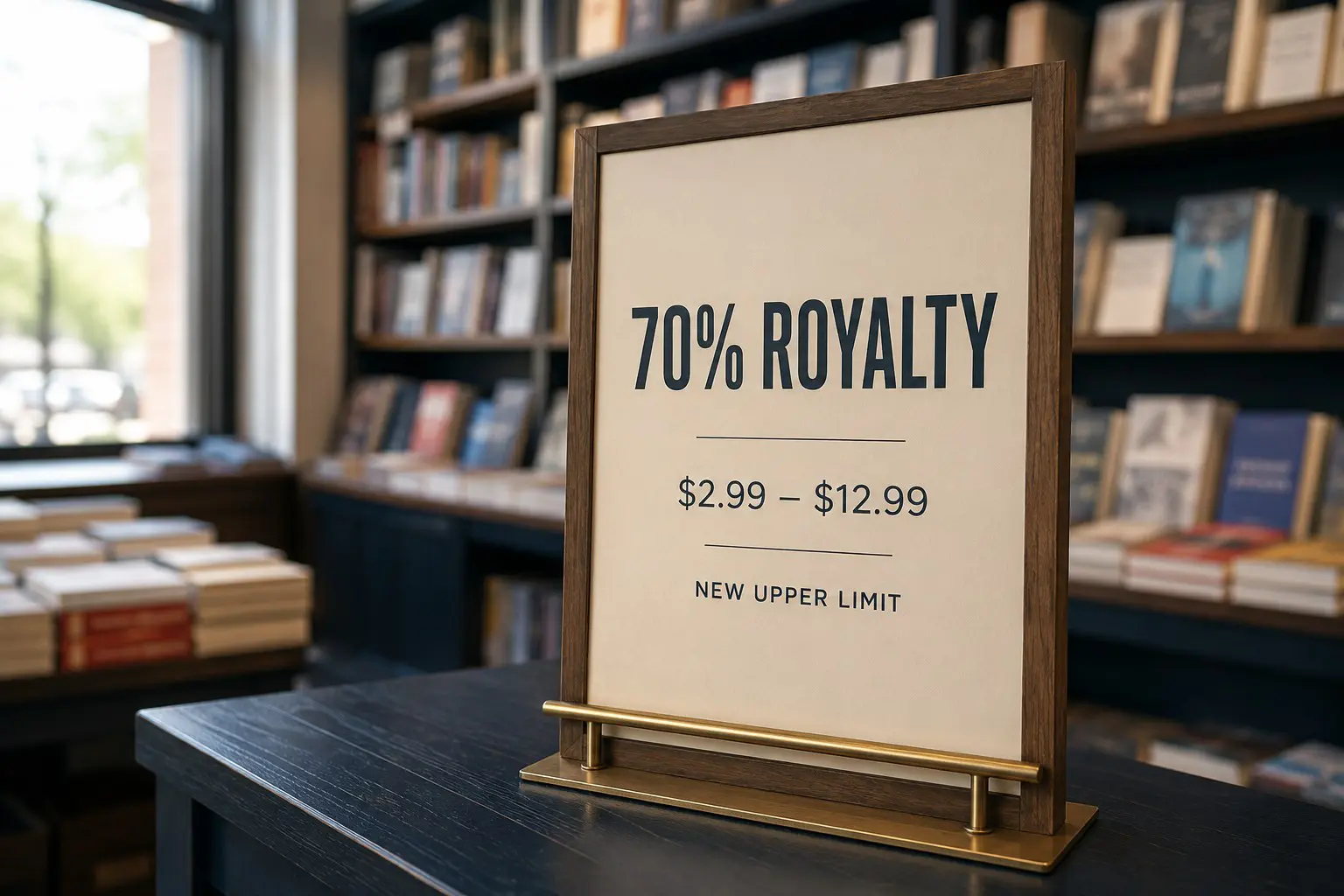
    If you sell ebooks through Amazon KDP, one of the platform’s longest-standing pricing rules just changed. As of 7 July 2026, the KDP 70% royalty band now runs from $2.99 to $12.99 on Amazon.com, up from the old $2.99 to $9.99 range. That $9.99 ceiling had been in place since Amazon introduced its 70% royalty option back in 2010, so the number has finally budged after about fifteen years of sitting still.

    It’s part of a broader run of 2026 KDP changes, alongside the DRM, AI-disclosure and ACX shifts covered in Four 2026 KDP and ACX Changes Every Indie Author Should Know.

    Before you dash off to reprice anything, here’s the honest headline: for most authors this changes nothing at all. For one particular group of books, though, it’s worth a five-minute check this week.

    The new KDP 70% royalty band: $2.99 to $12.99

    The mechanics are simple enough. Price a book anywhere from $2.99 to $12.99 on the 70% royalty option and it now earns 70%. Go above $12.99, or below $2.99, and you drop to the 35% option, exactly as before. The $2.99 floor hasn’t moved, and the 35% option itself is untouched.

    This applies across the KDP marketplaces, not just the US store. On Amazon.co.uk the 70% band now runs from £1.77 to £12.99, and the eurozone stores sit at €2.69 to €12.99. Amazon sets these as fixed local price points rather than live currency conversions, which is why the numbers don’t quite line up from one store to the next.

    And nothing on your existing titles changes automatically. Prices and royalty choices stay as they are until you go in and change them yourself. Translated editions created through Kindle Translate inherit whatever price and royalty option you set on the original.

    Nothing changes if you’re priced $2.99 to $9.99

    If your ebooks sit between $2.99 and $9.99 on the 70% option, which is where the bulk of genre fiction lives, this announcement is a non-event. Same price, same royalty, same everything. You don’t need to touch a thing.

    The change only matters to two groups: authors who were pricing above $9.99 and swallowing the 35% penalty to do it, and anyone who’d been holding a book down at $9.99 purely to protect the 70% rate.

    Who the $12.99 ceiling actually helps

    Three kinds of book stand to gain.

    Box sets and omnibus editions. This is the big one. A three or four book bundle often wants to sit above $9.99 to reflect its value, but until now that meant dropping to 35%. You can now price a bundle up to $12.99 and keep the full 70%. Trade coverage since the change suggests box sets are the first thing authors are repricing.

    Longer or premium non-fiction. Reference guides, business books and the like already command higher paperback prices, and their buyers tend to be less price-sensitive when a book promises a clear return. Here the ebook royalty band was the thing lagging behind what readers were willing to pay.

    Premium niche fiction. Epic fantasy doorstoppers and other high-value titles where $9.99 always felt like an artificial cap.

    The maths: what a $12.99 ebook pays at 70%

    Here’s why it matters in cash terms. Take a book priced at $12.99. Under the old rules it could only use the 35% option, paying about $4.55 a copy. On the 70% option it now pays roughly $9.03, after the small delivery fee. That’s a gain of about $4.48 on every single sale, for a book you don’t even have to reprice.

    List price35% royalty70% royalty (net of delivery)
    $9.99 (old ceiling)$3.50$6.93
    $10.99$3.85$7.63
    $12.99 (new ceiling)$4.55$9.03

    At $9.99 and below, nothing has changed. It’s the $10.00 to $12.99 band that’s just opened up.

    Mind the delivery fee on the 70% option

    One wrinkle catches people out: the 70% option carries a delivery fee, and the 35% option doesn’t. Amazon charges $0.15 per megabyte in the US (£0.10 in the UK), based on your file size rather than your price. For a normal text-only novel of a few hundred kilobytes, the fee lands around six cents, which is why the 70% royalty still wins so comfortably. A heavily illustrated book, or a chunky box set carrying lots of images, is a different story. Bigger file, bigger fee. Worth a glance before you assume 70% always comes out ahead.

    The cleanest move is a switch, not a reprice

    If you already have a book priced between $10.99 and $12.99 on the 35% option, the simplest win is to switch the royalty option to 70% at the same price. No repricing, no resetting your sales rank or review history, no signal to Amazon’s system that the price moved. Just a higher rate on the price you already have. That’s the first thing worth checking in your bookshelf.

    If you’re tempted to push a $9.99 book up to $12.99 to grab the bigger royalty, do the sums on volume first. Going from $9.99 to $12.99 is a 30% price rise, and if sales fall by more than the royalty gain, your total income can still drop. A higher rate isn’t the same as higher revenue.

    And none of this touches Kindle Unlimited. KU page reads are paid from the monthly Global Fund on a per-page basis, independent of your list price or royalty option, so nothing about your KU earnings changes here.

    Amazon is catching up, not leading

    A bit of context. This is Amazon closing a gap rather than opening one. Kobo already pays 70% up to $12.99 through Kobo Writing Life, so Amazon has matched it rather than beaten it. Apple Books and Barnes & Noble Press go further still, paying a flat 70% at any price with no ceiling at all. So the change is welcome, but plenty of authors have pointed out that Amazon stopped short. There were hopes the band might stretch to $14.99 or even $19.99. It didn’t.

    Watch for out-of-date royalty calculators

    One practical warning. The $9.99 rule stood for so long that plenty of pricing guides, royalty calculators and popular author-tool sites still show the old ceiling. In the days since the change, several well-known calculators were still telling authors $9.99 was the top of the 70% band. If you reach for a third-party calculator this week, check it reflects the new $12.99 figure before you trust its numbers.

    What to check in your KDP bookshelf this week

    Five minutes covers the lot:

    • Find any title priced between $10.99 and $12.99 on the 35% option, and switch it to 70%.
    • Run an eye over your box sets and omnibus editions, and decide whether a higher price with the full royalty now makes sense.
    • Leave everything priced $2.99 to $9.99 exactly where it is.

    That’s the whole change. Not a revolution, but for the right books it’s real money, and it’s been a long time coming.

    Keep reading: The KDP title creation limit is now two per format a week, The ACX legacy royalty model ends this year.