
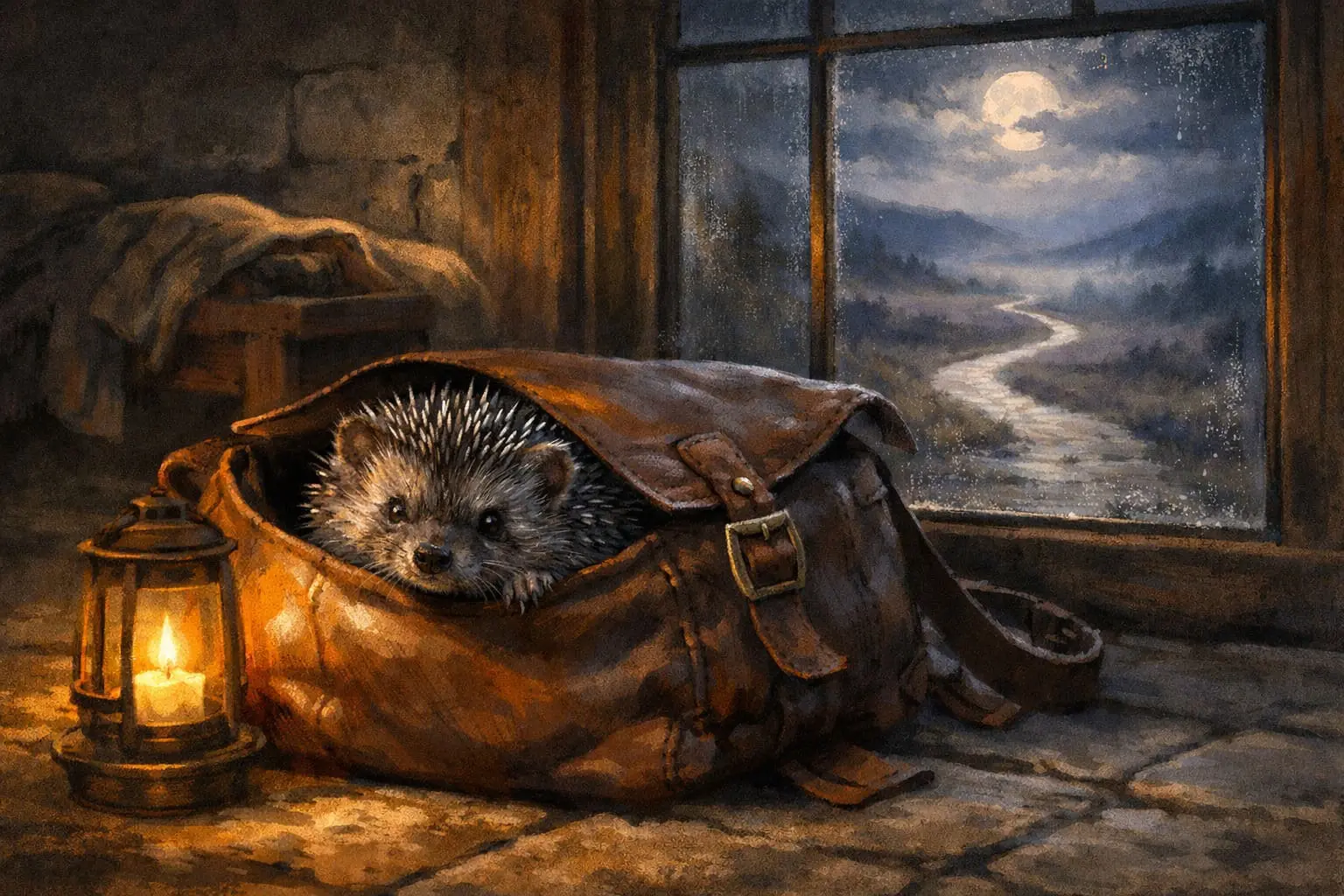
I didn’t plan the hedgehog.
When I started outlining The Last Route, I knew I wanted a familiar — some kind of animal companion for Wren to talk at during the long stretches between villages. Cozy fantasy practically demands one. But I’d been staring at my notes for weeks and nothing was clicking. Cats felt overdone. Owls felt borrowed. A dog would need walking, and Wren already walks two hundred miles every circuit.
Then I saw a hedgehog in my garden. It was 10pm, the thing was shuffling across the patio like it had somewhere extremely important to be, and it ignored me completely. I thought: that’s the energy.
Thistle has been the heart of the series ever since.
Stomps, not words
Thistle doesn’t talk. This was a deliberate choice that I nearly bottled several times during Book 1. A talking familiar is easier to write — you can have actual dialogue, deliver information cleanly, crack jokes. But I kept coming back to the idea that the most meaningful communication isn’t always verbal.
Thistle communicates in stomps. One stomp means yes. Two means no. Three rapid stomps mean pay attention right now. There’s also a quill-rustle that means something closer to contemplation, and a full curl-up that means displeasure or — depending on context — absolute refusal to engage with whatever nonsense is currently happening.
The readers figured out the system faster than Wren did. By Book 3, people were reading Thistle’s stomps before the text confirmed them. That’s when I knew it was working.
More than a pet
I can’t say too much without spoiling the later books, but Thistle is not a pet. If you’ve read The Deep Paths (Book 6), you know what I mean. The hedgehog has secrets. The hedgehog has history. And the hedgehog chose Wren — not the other way around.
What I can say is this: Thistle is fine in every book. That’s not a spoiler, it’s a promise. The cozy fantasy contract means no harm comes to the beloved animal companion. I get asked about this more than anything else — “Is Thistle okay?” — and the answer is always yes. Grumpy, occasionally inconvenient, but always okay.
The scenes that write themselves
Some characters resist you on the page. Thistle never has. Every scene with the hedgehog comes out faster than anything else I write, because Thistle’s responses are so clear in my head. The indignant stomp when someone gets too close to the satchel. The slow blink when Wren is being stubborn. The way Thistle sits on whatever document Wren is trying to read — not because it’s a cat-like “pay attention to me” move, but because Thistle genuinely disagrees with the content.
My favourite Thistle moment is in Book 4, during the First Frost gathering. I won’t spoil it. But if you’ve read it, you know the one I mean — and you probably felt the same way I did when I wrote it.
Why hedgehogs work in cozy fantasy
There’s something inherently cozy about a hedgehog. They’re small. They’re round. They’re nocturnal and slightly mysterious. They curl up when they’re overwhelmed, which is the most relatable thing any fictional creature has ever done. And they have this air of quiet competence — like they know exactly what they’re doing, even when it looks to everyone else like they’re just ambling through the underbrush.
If that sounds like a description of the ideal cozy fantasy protagonist, you’re not wrong. Thistle is Wren’s mirror in a lot of ways. Small, underestimated, prickly on the outside, unreasonably determined.
If you haven’t met Thistle yet, Dead Letters (Book 1) is where it starts — with a hedgehog sleeping in a satchel and an extremely annoyed postal courier who doesn’t yet realise her life just changed.
Keep reading: Why I Wrote a 20-Book Sapphic Cozy Fantasy About a Postal Courier, Introducing The Last Route: Cozy Fantasy on the Move.
Want a free bonus story? Quills & Quiet is told entirely from Thistle’s perspective. Get it free at heppesmithpublishing.com/thistle.
James Heppe-Smith is the author of The Last Route, a 20-book sapphic cozy fantasy series published by Heppe-Smith Publishing.
Leave a Reply