Category: The Last Route Series

  • The Cozy Fantasy Familiar Guide: From Cats to Hedgehogs

    The Cozy Fantasy Familiar Guide: From Cats to Hedgehogs

    Every cozy fantasy needs a familiar. It’s not an official rule, but try to find a beloved cozy fantasy without one — the companion creature is as central to the genre as warm endings and found family. What’s changed is the creatures themselves. Cats used to dominate (and they’re still going strong), but the best cozy fantasies are getting increasingly creative about what tags along for the ride.

    Here’s a field guide to the familiars readers love most, the books that feature them, and why the right companion creature can make or break a cozy fantasy.

    A note on the moment this guide arrives in: at the British Book Awards on 11 May 2026, the Nibbies added a dedicated Science Fiction and Fantasy category for the first time, won by SenLinYu’s Alchemised. UK trade publishing has, as of this spring, formally recognised a genre that for years sat at the BookTok fringe. Familiars, cozy worldbuilding and warm-ending fiction are, suddenly, part of the mainstream conversation.

    Why Familiars Work So Well in Cozy Fantasy

    A familiar does three things at once. It provides comic relief — a creature with its own personality and opinions creates natural humour without the author having to force jokes. It provides emotional grounding — when the protagonist is struggling, the familiar is there, steady and present, a warm weight in their lap or their bag or on their shoulder. And it provides a relationship that doesn’t require vulnerability in the same way human relationships do. The protagonist can love the familiar before they’re ready to love anyone else.

    In cozy fantasy specifically, the familiar also signals safety. A genre with a quirky hedgehog on the cover is not a genre that’s going to traumatise you. The creature is a promise: this story is gentle enough to include something small and beloved, and it will stay that way.

    The Classic: Cats

    Cats are the default familiar for a reason — they’re independent, mysterious, and slightly smug, which makes them ideal cozy fantasy characters. They don’t fawn. They choose. And a cat choosing the protagonist says more about that character’s worthiness than any prophecy could.

    Heather Fawcett’s upcoming Agnes Aubert’s Magical Cat Shelter goes all-in on feline magic, and the Maple Hollow series weaves cats into its paranormal cozy world. If you love cats in your fantasy, the genre has you covered. Thoroughly.

    The Scene-Stealer: Hedgehogs

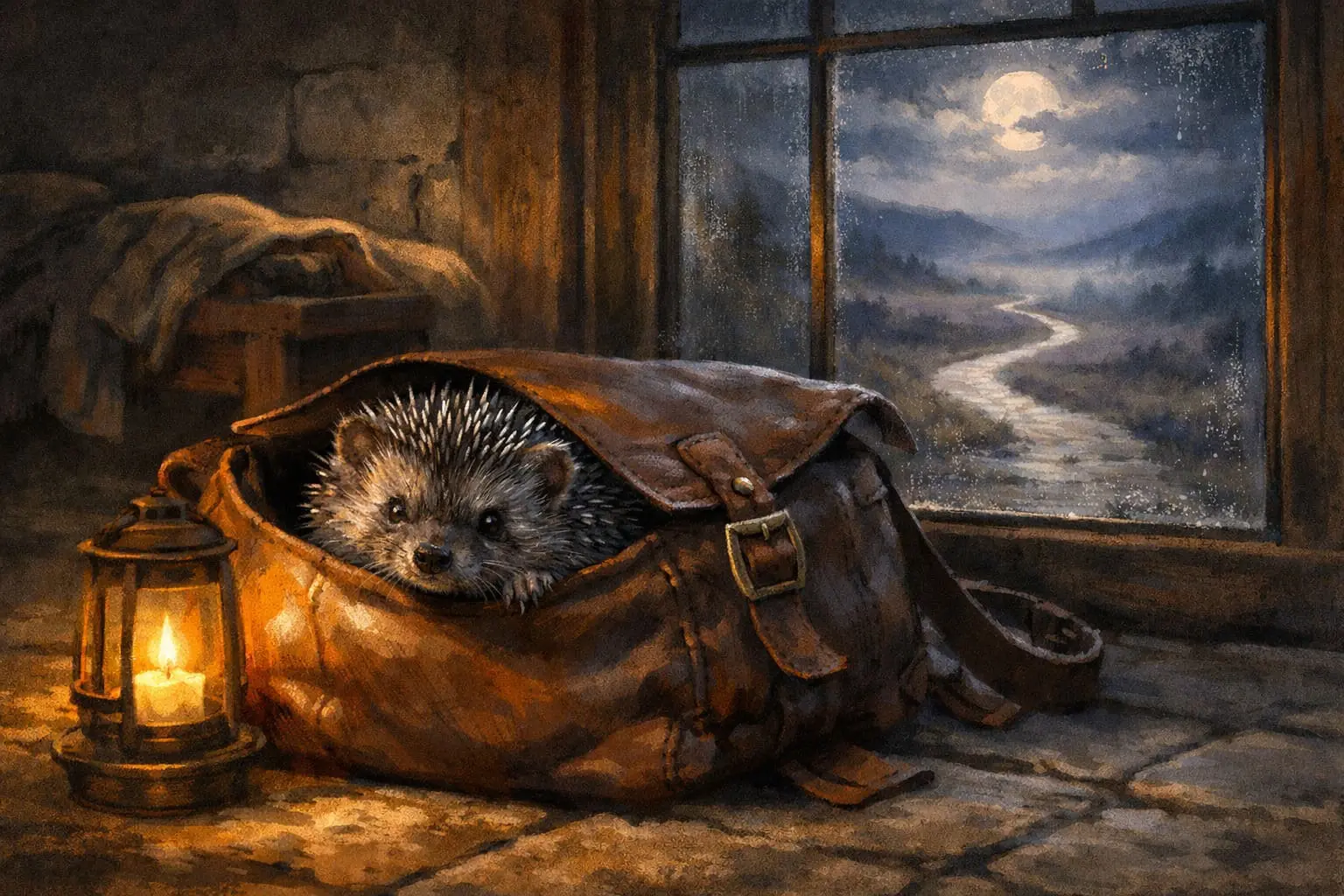
    I’m biased here, obviously. Thistle — the hedgehog in The Last Route — appeared uninvited in Wren’s courier bag during her first circuit and has refused to leave since. It communicates in stomps. One for yes, two for emphasis, three for pay attention, rapid stomping for danger. It seems to know things a hedgehog shouldn’t know. Readers adore him more than any other character in the series, which I’ve learned to accept with grace.

    Hedgehogs work as familiars because they’re small enough to be carried, prickly enough to have personality, and unusual enough to feel distinctive. In a genre full of cats, a hedgehog stands out — and in a story about a courier, a creature that fits in a bag and has opinions about the route is the perfect companion.

    The Heartwarmers: Tea Dragons

    Kay O’Neill’s The Tea Dragon Society invented a familiar so perfect that it spawned an entire graphic novel series. Tea dragons are tiny dragons that grow actual tea leaves, and caring for them is an ancient art passed down through generations. The concept is pure cozy genius — it combines the companion creature trope with the craft/competence trope in a single adorable package. If you’ve ever wanted to learn a gentle magical skill alongside a character, the Tea Dragon books are exactly what you’re looking for.

    The Mythic: Phoenixes, Gryphet Chicks, and Magical Zoo Creatures

    Some cozy fantasies go bigger with their creatures. The Phoenix Keeper by S.A. MacLean centres on the care of the last known phoenix in a magical zoo — a premise that turns creature care into the primary plot rather than a secondary comfort. Travis Baldree’s Bookshops & Bonedust features a gryphet chick that readers fell in love with on sight. And Becky Chambers’ robot Mosscap in A Psalm for the Wild-Built isn’t technically a familiar, but fills the same emotional role — a non-human presence that asks good questions and makes the protagonist (and reader) think about what they actually need.

    The Unexpected: Mules, Sourdough Starters, and Eldritch Monsters

    The genre’s getting creative. The Teller of Small Fortunes features a mule and a slightly magical cat — both with more personality than most human side characters. A Wizard’s Guide to Defensive Baking by T. Kingfisher has a sentient sourdough starter named Bob. And How to Get a Girlfriend (When You’re a Terrifying Monster) turns the familiar concept completely inside out by making the monster the love interest.

    The lesson: it’s not the species that matters, it’s the personality. Give a creature opinions, let it disagree with the protagonist, and make it irreplaceable to the story. That’s what makes a familiar work.

    Writing Your Own Familiar (Author Tips)

    If you’re writing cozy fantasy and designing a familiar, here’s what I’ve learned from Thistle:

    Don’t explain everything. Thistle’s communication system — the stomps, the quill positions, the silences — works because readers learn to read him alongside Wren. Mystery makes a familiar more interesting, not less. Give them autonomy. A familiar that just sits on a shoulder is a prop. A familiar that wanders off, makes choices, and occasionally knows better than the protagonist is a character. Let them be funny without being comic relief. The humour should come from personality, not from the creature being a punchline. And make them matter to the plot, not just the atmosphere. If you can remove the familiar and nothing changes, it’s decoration. If removing them breaks the story, they’re doing their job.


    Why this matters right now

    If you are reading this in May 2026, you are reading it at the genre’s strongest commercial moment so far. Cozy fantasy and romantasy are outperforming general fiction by a wide margin on BookTok, with industry trackers placing the genre roughly 40% ahead of the wider category. Sapphic and queer protagonists are an explicitly named 2026 growth area within romantasy — the genre is making room for stories like this, in a way it visibly was not five years ago. If you have been waiting for a moment to start reading cozy fantasy, this is a sensible one. If you have been waiting for a series with a hedgehog and a hedge witch and a slow-burn sapphic romance you can trust to land, the next book in The Last Route — The Courier’s Wedding — arrives 28 May 2026, and the rest of the series is on Kindle Unlimited if you want to start at the beginning.

    Want more cozy fantasy recommendations? Browse our Legends & Lattes read-alikes, our sapphic cozy fantasy reading list, or start The Last Route (and meet Thistle) from Book 1.

    Want a free bonus story? Join the reader community and get Quills & Quiet — a Last Route short story — at heppesmithpublishing.com/thistle.


    James Heppe-Smith is the author of The Last Route, a 20-book sapphic cozy fantasy series featuring a hedgehog who is, by reader consensus, the real protagonist. He writes from Northern Cyprus with two rescue dogs who have no magical abilities whatsoever but remain very good boys.

    As an Amazon Associate, I earn from qualifying purchases. Book links in this post are affiliate links — they cost you nothing extra, but help support this site and the writing of more cozy fantasy.
  • What Readers Ask Most About The Last Route

    What Readers Ask Most About The Last Route

    I keep a running list of the questions readers ask me — by email, in reviews, on the rare occasion I surface on social media. Some are about the world. Some are about the writing process. And one comes up so often it might as well be the series tagline.

    Is Thistle okay?

    Yes. Thistle is okay. Thistle is always okay. Now let’s get to the rest.

    Do I need to read the books in order?

    Yes — and I know that’s not the answer people want when they’ve just discovered the series at Book 5. But the character relationships build across books. Wren’s arc from bitter exile to someone who actually lets herself care only works if you’ve walked the route with her from the beginning. Each book has a complete, satisfying ending (no cliffhangers, ever), but the full weight of the story accumulates.

    Dead Letters (Book 1) is where to start. Always.

    Is there spice?

    Closed door. The romance between Wren and Rowan is the emotional heart of the entire series — it’s central, not a subplot — but intimate scenes are fade-to-black. If you’re looking for a number on the spice scale, it’s a 1. The slow burn is the point. The tension comes from two people who are terrible at admitting what they feel, not from what happens behind a closed door.

    Is it suitable for younger readers?

    Yes. No graphic violence, no explicit sexual content, no dark themes. I’d say comfortable for readers 14 and up. A few parents have emailed me to say their teenagers are reading it, which is genuinely one of the nicest things about this whole experience.

    How many books will there be?

    Twenty. That number is locked in and has been since before I wrote Book 1. The series follows a seasonal rotation — autumn, winter, spring, summer — across twenty years of Wren’s life. Each book covers one season. By the end, she’s forty-eight, happily married, semi-retired, and growing old in Mosshaven with Rowan and a very elderly hedgehog.

    That’s not a spoiler. It’s a promise.

    Does anyone die?

    One character, much later in the series, dies peacefully and surrounded by the people who love them. I won’t say who or when. It’s handled with warmth and it’s the only significant death in twenty books. No shock deaths, no tragedy for the sake of stakes, no killing characters to prove the story is “serious.”

    And before you ask again: Thistle is fine. In every single book. That’s a guarantee.

    What’s Aeldra like?

    Aeldra is roughly the size of Britain, with a temperate climate and four distinct seasons. The Last Route runs through the northwestern corner: coastal cliffs along the Thorncoast, highland moors in the Greymist Hills, and ancient forest in the Oldwood. It’s the kind of landscape that changes how you breathe when you read about it — salt air, heather, old stone, deep trees.

    I’ll have more about the world in an upcoming blog post, but the series hub has the overview.

    What’s Object Empathy?

    It’s Wren’s magic — the ability to sense the emotional history of objects she touches. The Academy called it a failure because it didn’t fit their classification system. On the route, it makes her the best courier anyone’s ever had. She can feel which letters are urgent, which packages carry grief, which deliveries need gentleness. For a character who claims not to care about people, it’s a deeply inconvenient gift.

    Will there be audiobooks?

    That’s the plan. I don’t have a timeline to share yet, but it’s something I’m actively working on. When there’s news, I’ll announce it to the reader community first.

    Keep reading: Meet Thistle: The Hedgehog Who Stole the Series, Why I Wrote The Last Route.

    Want a free bonus story? Quills & Quiet is told from Thistle’s perspective. Get it free at heppesmithpublishing.com/thistle.


    James Heppe-Smith is the author of The Last Route, a 20-book sapphic cozy fantasy series published by Heppe-Smith Publishing.

  • Meet Thistle: The Hedgehog Who Stole the Series

    Meet Thistle: The Hedgehog Who Stole the Series

    I didn’t plan the hedgehog.

    When I started outlining The Last Route, I knew I wanted a familiar — some kind of animal companion for Wren to talk at during the long stretches between villages. Cozy fantasy practically demands one. But I’d been staring at my notes for weeks and nothing was clicking. Cats felt overdone. Owls felt borrowed. A dog would need walking, and Wren already walks two hundred miles every circuit.

    Then I saw a hedgehog in my garden. It was 10pm, the thing was shuffling across the patio like it had somewhere extremely important to be, and it ignored me completely. I thought: that’s the energy.

    Thistle has been the heart of the series ever since.

    Stomps, not words

    Thistle doesn’t talk. This was a deliberate choice that I nearly bottled several times during Book 1. A talking familiar is easier to write — you can have actual dialogue, deliver information cleanly, crack jokes. But I kept coming back to the idea that the most meaningful communication isn’t always verbal.

    Thistle communicates in stomps. One stomp means yes. Two means no. Three rapid stomps mean pay attention right now. There’s also a quill-rustle that means something closer to contemplation, and a full curl-up that means displeasure or — depending on context — absolute refusal to engage with whatever nonsense is currently happening.

    The readers figured out the system faster than Wren did. By Book 3, people were reading Thistle’s stomps before the text confirmed them. That’s when I knew it was working.

    More than a pet

    I can’t say too much without spoiling the later books, but Thistle is not a pet. If you’ve read The Deep Paths (Book 6), you know what I mean. The hedgehog has secrets. The hedgehog has history. And the hedgehog chose Wren — not the other way around.

    What I can say is this: Thistle is fine in every book. That’s not a spoiler, it’s a promise. The cozy fantasy contract means no harm comes to the beloved animal companion. I get asked about this more than anything else — “Is Thistle okay?” — and the answer is always yes. Grumpy, occasionally inconvenient, but always okay.

    The scenes that write themselves

    Some characters resist you on the page. Thistle never has. Every scene with the hedgehog comes out faster than anything else I write, because Thistle’s responses are so clear in my head. The indignant stomp when someone gets too close to the satchel. The slow blink when Wren is being stubborn. The way Thistle sits on whatever document Wren is trying to read — not because it’s a cat-like “pay attention to me” move, but because Thistle genuinely disagrees with the content.

    My favourite Thistle moment is in Book 4, during the First Frost gathering. I won’t spoil it. But if you’ve read it, you know the one I mean — and you probably felt the same way I did when I wrote it.

    Why hedgehogs work in cozy fantasy

    There’s something inherently cozy about a hedgehog. They’re small. They’re round. They’re nocturnal and slightly mysterious. They curl up when they’re overwhelmed, which is the most relatable thing any fictional creature has ever done. And they have this air of quiet competence — like they know exactly what they’re doing, even when it looks to everyone else like they’re just ambling through the underbrush.

    If that sounds like a description of the ideal cozy fantasy protagonist, you’re not wrong. Thistle is Wren’s mirror in a lot of ways. Small, underestimated, prickly on the outside, unreasonably determined.

    If you haven’t met Thistle yet, Dead Letters (Book 1) is where it starts — with a hedgehog sleeping in a satchel and an extremely annoyed postal courier who doesn’t yet realise her life just changed.

    Keep reading: Why I Wrote a 20-Book Sapphic Cozy Fantasy About a Postal Courier, Introducing The Last Route: Cozy Fantasy on the Move.

    Want a free bonus story? Quills & Quiet is told entirely from Thistle’s perspective. Get it free at heppesmithpublishing.com/thistle.


    James Heppe-Smith is the author of The Last Route, a 20-book sapphic cozy fantasy series published by Heppe-Smith Publishing.

  • The Second Summer: What’s Coming in Book 7

    The Second Summer: What’s Coming in Book 7

    The Second Summer — Book 7 of The Last Route — releases 23 April 2026. Here’s what you can expect without any spoilers for the new book or the six that came before it.

    Spring on the Route

    Book 7 is a spring book — the third spring Wren has walked the route, and the first time it’s felt like hers rather than like a punishment.

    The seasonal rotation is one of my favourite things about writing this series. Every book takes on the character of its season, and spring on the Last Route means thawing paths, returning birds, Rowan’s impossible garden coming back to life, and the route communities shaking off winter and looking outward again. There’s an energy to spring books that the autumn and winter entries don’t have — a sense of things beginning rather than settling.

    This one needed that energy.

    The Threat

    For the first six books, the challenges Wren faces have been personal — her own bitterness, her isolation, learning to trust her magic and the people around her. In The Second Summer, the challenge comes from outside.

    The Guild’s Route Optimization Committee has decided the Last Route might not be worth keeping. It’s remote, expensive to maintain, and serves a small number of communities. From a budget spreadsheet in Aldmere, it looks like a line item that could be cut.

    From the route itself, it looks like something else entirely.

    This is still cozy fantasy — the “villain” is a bureaucratic review, not a dark lord — but the stakes feel real because they threaten the thing Wren has spent six books building: her connection to the communities along the route. The people who wait for her. The places that have become home.

    What It’s Really About

    Without giving away how things unfold, I can say that The Second Summer is about what communities do when they’re asked to justify their own existence. It’s about the gap between how institutions measure value and how people experience it. And it’s about Wren realising that the thing she was assigned to as a dead-end posting has become the thing she’d fight to keep.

    If the first phase of the series (Books 1–5) was about Wren finding reasons to stay, this book is the moment she stops needing reasons. She stays because this is where she belongs.

    The Tagline

    “Some things are worth fighting for. Others are worth waiting for.”

    Both halves of that sentence matter in this book.

    Where to Start If You’re New

    Book 7 isn’t the place to jump in — the emotional payoff depends on knowing the route, the communities, and what Wren has been through. Start with Dead Letters (Book 1), where Wren arrives on the Last Route for the first time, thoroughly unimpressed. Six books will take you to this point, and at roughly 60,000 words each, they move fast.

    Find the full series and reading order on the Last Route series page.

    Release Details

    The Second Summer (The Last Route, Book 7) releases 23 April 2026 on Kindle, paperback, and Audible. It’s available for preorder now.

    The series continues with new books every couple of months after that. Twenty books total, covering twenty years of Wren’s life on the route.

    Keep reading: Introducing The Last Route: Cozy Fantasy on the Move, Why I Wrote a 20-Book Sapphic Cozy Fantasy About a Postal Courier.

    Want a free bonus story? Join the reader community and get Quills & Quiet — a Last Route short story — at heppesmithpublishing.com/thistle.


    James Heppe-Smith is the author of The Last Route, a 20-book sapphic cozy fantasy series published by Heppe-Smith Publishing. The Second Summer is the first spring book that made him cry while writing it, which he considers a good sign.

    As an Amazon Associate, I earn from qualifying purchases. Book links in this post are affiliate links — they cost you nothing extra, but help support this site and the writing of more cozy fantasy.
  • Introducing The Last Route: Cozy Fantasy on the Move

    Introducing The Last Route: Cozy Fantasy on the Move

    If you’ve landed here wondering what The Last Route is and whether it’s for you — this is the post. No spoilers, no deep lore, just everything you need to know to decide whether a 20-book sapphic cozy fantasy about a postal courier sounds like your kind of thing.

    (Spoiler: if you like found family, slow-burn romance, hedgehogs with secrets, and stories where nobody has to save the world, it probably is.)

    The Premise

    Wren Ashwick trained at the Academy of Practical Magics. She failed. Not because she lacked talent, but because her talent didn’t fit into any of their categories. They called it a malfunction. She calls it a career-ending humiliation.

    Now she’s been assigned to the Last Route — the most remote postal circuit in the realm of Aeldra. It’s a three-week loop through coastal cliffs, highland moors, and ancient forest, delivering mail to communities so far from the capital that most people forget they exist. It’s considered the worst posting in the Postal Guild. A dead end for couriers nobody wants.

    Wren is furious about this. She plans to do her time and get reassigned somewhere that matters.

    She does not get reassigned.

    The World

    Aeldra is a roughly Britain-sized realm with four distinct seasons and a gentle, lived-in quality. The capital is far to the south. The Last Route runs through the northwest corner — a triangle of coast, hills, and forest where life moves at a slower pace and old magic lingers in places the Academy has forgotten about.

    The route has three legs. The Coastal Stretch passes through fishing villages and a lighthouse kept by a woman who’s recorded three hundred years of storms. The Highland Stretch crosses moorland and shepherding country, passing through the village of Mosshaven — a place that will become very important. And the Forest Passage cuts through the Oldwood, an ancient forest with a presence of its own, ending at a village called Hollowbrook that feels slightly out of time.

    Each stop has its own character, its own people, and its own reasons for needing a courier who keeps showing up.

    The Characters

    Wren Ashwick — the courier. Grumpy, competent, quietly brilliant in ways she hasn’t figured out yet. Her magic lets her sense the emotional history of objects, which is either a gift or a curse depending on how many sad letters she’s carrying that day.

    Rowan — the green witch of Mosshaven. Patient, warm, grounded. She has a cottage with a red door and a garden that shouldn’t be possible — things bloom out of season, plants grow where they have no business growing. She’s the sunshine to Wren’s grumpy, and their slow-burn romance is the emotional heart of the series.

    Thistle — a hedgehog. Appeared uninvited in Wren’s courier bag during her first circuit and has refused to leave. Communicates in stomps. Seems to know things a hedgehog shouldn’t know. Readers love Thistle more than any other character, and honestly, fair enough.

    Beyond the core three, the route is populated with lighthouse keepers, retired couriers, shepherds, scholars, forest wardens, and the kind of small-community characters who make you feel like you’ve visited a real place.

    The Cozy Promise

    Every book in the series delivers on a set of guarantees:

    The stakes stay personal and community-level. There’s no dark lord, no war, no apocalypse. The magic is gentle and grows through patience, not power. The romance is sapphic, slow-burn, and central — not a subplot. Found family builds across the entire series. Every single book ends warm. And Thistle is in every single one.

    If you’ve read cozy fantasy before — Legends & Lattes, Can’t Spell Treason Without Tea, The House in the Cerulean Sea — you know the emotional contract. The Last Route honours it completely. The difference is the setting: instead of one cozy shop, you get an entire route full of communities. And instead of a single book, you get twenty.

    The Structure

    Twenty books, each around 60,000 words. Each book covers one season, and the series rotates — autumn, winter, spring, summer — so you experience Aeldra in every light across twenty years of Wren’s life.

    The series is built in four phases. Books 1–5 are about survival — finding reasons to stay. Books 6–10 are about belonging — opening to love and community. Books 11–15 are about building — creating something lasting. And Books 16–20 are about home — growing old together in the place you made yours.

    Each book works as a complete story with a warm resolution. There are no cliffhangers. You can read at your own pace without anxiety.

    Where to Start

    Dead Letters (Book 1) is where Wren arrives on the Last Route for the first time, deeply unimpressed. It’s autumn. The coast is beautiful and unwelcoming. The locals are cautious. And a hedgehog has taken up residence in her bag.

    Six books are published now. The Second Summer (Book 7) releases 23 April 2026, with new books following every couple of months after that.

    You can find the full series, with descriptions and reading order, on the Last Route series page.

    Keep reading: Why I Wrote a 20-Book Sapphic Cozy Fantasy About a Postal Courier, What Is Cozy Fantasy? A Genre Guide for 2026.

    Want a free bonus story? Join the reader community and get Quills & Quiet — a Last Route short story — at heppesmithpublishing.com/thistle.


    James Heppe-Smith is the author of The Last Route. He lives in Northern Cyprus with two rescue dogs and a growing conviction that hedgehogs are underrepresented in fiction.

    As an Amazon Associate, I earn from qualifying purchases. Book links in this post are affiliate links — they cost you nothing extra, but help support this site and the writing of more cozy fantasy.
  • Why I Wrote a 20-Book Sapphic Cozy Fantasy About a Postal Courier

    Why I Wrote a 20-Book Sapphic Cozy Fantasy About a Postal Courier

    The honest answer is that I couldn’t find the book I wanted to read.

    I’d been deep into cozy fantasy for a couple of years — working through everything from Legends & Lattes to Can’t Spell Treason Without Tea to A Psalm for the Wild-Built — and I kept noticing the same thing. The settings clustered. Coffee shops, tea shops, bookshops, bakeries, magical inns. Beautiful settings, all of them. But after the fifth enchanted café, I started wondering: what else could cozy fantasy look like?

    Not what else could it be about — the genre’s emotional core is perfect and doesn’t need fixing. Found family, warm endings, competence, low stakes. That’s the promise, and I love it. But the container for those stories kept defaulting to a shop. A character settles somewhere, builds something, and the community comes to them.

    I wanted the opposite. A character who goes to the community. Who walks between villages, crosses moorland and coastline and deep forest, and carries connection with her — literally, in the form of mail.

    The Postal Route Idea

    I did what any sensible person does when they have a creative idea: I made a spreadsheet. I mapped every cozy fantasy setting I could find against two axes — saturated versus underserved, and static versus mobile. Coffee shops: saturated, static. Bookshops: saturated, static. Magical inns: moderately competitive, static.

    The mobile column was almost empty. Travelling artisans, maybe. Merchant caravans. And then, right at the bottom of my brainstorm: postal courier.

    I stared at that for about three days. A postal route gives you everything a shop does — a regular cast of characters, a home base, a sense of routine and ritual — but it also gives you the road. New faces at every stop. Landscapes that shift with the seasons. A protagonist who earns her community through showing up, reliably, in every kind of weather.

    And it gives you mail. Objects that carry weight and meaning. Letters that matter to the people waiting for them. Packages with history. For a character with the ability to sense the emotional resonance of objects, a courier’s bag is the most interesting place in the world.

    Why Sapphic

    Because that’s the love story I wanted to tell. Wren is prickly, exhausted, and convinced she’s been thrown away by every institution that was supposed to value her. Rowan is patient, rooted, and quietly extraordinary. They meet because Wren’s route passes through Rowan’s village, and at first it’s just tea and professional courtesy. Then it’s something Wren isn’t ready for.

    The grumpy/sunshine dynamic is one of my favourite things in fiction, and it works especially well in cozy fantasy because the genre gives it room to breathe. There’s no ticking clock forcing the romance forward. No third-act betrayal manufacturing drama. Just two people learning to trust each other, one delivery at a time.

    Sapphic cozy fantasy is also, frankly, a space where readers are hungry for more. The demand is real, the community is passionate, and the shelf isn’t as full as it should be. I wanted to add something to it that felt genuine — not a token subplot, but a love story that’s the emotional centre of the entire twenty-book series.

    Why Twenty Books

    Because the story I wanted to tell isn’t about a single season. It’s about a life.

    Wren arrives on the Last Route bitter, underqualified in her own mind, and determined not to care. Twenty books later, she’s the beloved elder of the communities she serves, married to the woman she fell for on her second circuit, and training the next generation of couriers. That arc — from exile to home — takes time. It takes years of walking the same path and discovering that the path was always the point.

    Each book covers one season. The series rotates through autumn, winter, spring, and summer, so readers get to experience Aeldra in every light. The route feels different under snow than it does under harvest sun. The communities change. Wren changes. And the magic — which starts as a confusing, involuntary thing she’d rather not have — slowly becomes the most important gift anyone on the route has ever carried.

    Twenty books also lets me keep the cozy promise without compromise. The stakes never need to escalate. I don’t need to manufacture a dark lord in Book 15 because the first fourteen were “too quiet.” The genre’s emotional logic — that warmth and connection are enough — holds across the whole series. It’s not about escalation. It’s about return.

    The Hedgehog

    Every cozy fantasy needs a familiar, and I was not going to use a cat. Cats are wonderful, but cozy fantasy has enough of them.

    Thistle is a hedgehog. A small, opinionated hedgehog who communicates in stomps — one for yes, two for emphasis, three for pay attention, rapid stomping for danger. Thistle appeared in Wren’s courier bag uninvited in Book 1 and has refused to leave since.

    What readers don’t know yet — and what Wren is only beginning to figure out — is that Thistle is far more than a cute companion. But I won’t spoil that here. I’ll just say that the hedgehog earns its place in the story in ways that go well beyond comic relief.

    Thistle is also the character readers mention most in messages and reviews. More than Wren. More than Rowan. The hedgehog. I’ve made my peace with this.

    Writing From Northern Cyprus

    I live in Northern Cyprus now, after a long route of my own — England, Germany, and then the eastern Mediterranean. The landscape here doesn’t look much like Aeldra (too many olive trees, not enough rain), but the rhythm of small-community life absolutely shaped the series. The way everyone knows the postman’s name. The way neighbours show up with food when something goes wrong. The way a place can feel like the edge of the world and the centre of it at the same time.

    The Last Route is fiction, but the feeling it’s built on is real. That sense of belonging to a place not because you were born there, but because you kept showing up.

    Where Things Stand

    Six books are published. The Second Summer (Book 7) releases 23 April 2026. The series runs to twenty books, and I’m writing ahead of the publication schedule, so the pace should stay steady — a new book every couple of months.

    If you’ve read this far and you’re curious, start with Dead Letters (Book 1). Wren is at her grumpiest. Thistle is at his most mysterious. And the Last Route is about to become much more than a delivery run.

    You can find the full series on the Last Route series page.

    Keep reading: Introducing The Last Route: Cozy Fantasy on the Move, What Is Cozy Fantasy? A Genre Guide for 2026.

    Want a free bonus story? Join the reader community and get Quills & Quiet — a Last Route short story — at heppesmithpublishing.com/thistle.


    James Heppe-Smith is the author of The Last Route, a 20-book sapphic cozy fantasy series published by Heppe-Smith Publishing. He lives in Northern Cyprus with two rescue dogs who believe firmly in the cozy promise of warm endings and regular meals.

    As an Amazon Associate, I earn from qualifying purchases. Book links in this post are affiliate links — they cost you nothing extra, but help support this site and the writing of more cozy fantasy.